
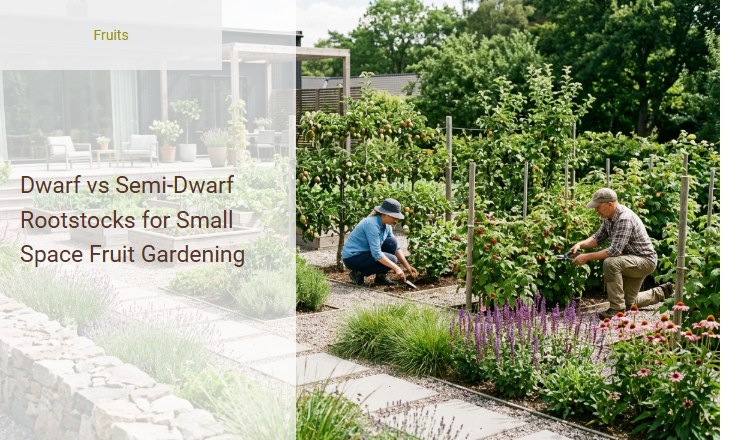
Aspiring orchardists with limited backyard space often struggle to cultivate abundant fruit trees without completely overwhelming their gardens. To solve this spatial puzzle, we must first look beneath the soil; a tree's ultimate height, lifespan, and vigor are primarily dictated by its rootstock rather than the fruit variety itself.
Selecting the correct rootstock grants you the ability to harvest bushels of full-sized fruit from a footprint no larger than a patio umbrella. However, as an educational stipulation, note that highly dwarfing rootstocks trade resilience for size, often requiring permanent staking and more diligent watering. For instance, choosing an ultra-dwarf M27 rootstock versus a semi-dwarf M7 determines whether your apple tree tops out at a manageable 6 feet or a broader 15 feet.
In this guide, we will compare dwarf and semi-dwarf rootstocks, analyzing their growth habits, soil adaptability, and management needs, to help you select the perfect foundation for your compact home orchard.
Introduction to Rootstocks in Backyard Orchards
When planning a home orchard, many gardeners focus entirely on the fruit variety, such as a crisp Honeycrisp apple or a sweet Elberta peach. However, the true foundation of your tree's success lies beneath the soil. A rootstock is the subterranean portion of a grafted tree that controls its size, vigor, pest resistance, and precocity. Selecting the right base is especially critical for those with limited space, as the choice between dwarf rootstocks and semi-dwarf rootstocks determines how much room your tree will occupy, how soon it will bear fruit, and how much physical support it will require over its lifetime.
Understanding Dwarf Rootstocks
Dwarf rootstocks are genetically selected to severely limit the overall height and spread of the grafted fruit tree. They are the ideal choice for urban gardeners, small backyards, and intensive growing systems like espaliers.
- Average Height: Typically reaches only 8 to 10 feet tall at maturity.
- High Efficiency: Directs energy away from wood production and into fruit development.
- Compact Footprint: Requires very little lateral space, allowing for tight planting densities.
- Early Fruiting: Extremely quick to transition from juvenile growth to active fruit production.
Understanding Semi-Dwarf Rootstocks
Semi-dwarf rootstocks strike a balance between the highly restricted growth of dwarf varieties and the massive, unmanageable scale of seedling (standard-sized) trees. These rootstocks offer robust vigor suitable for traditional backyard layouts.
- Typical Height Range: Generally matures to a manageable 12 to 15 feet in height and width.
- Stronger Vigor: Exhibits greater vegetative growth and stronger trunk development than dwarf selections.
- Suburban Suitability: Fits perfectly in average suburban yards where a moderate-sized shade and fruit tree is desired.
- Self-Supporting Nature: Develops a root system capable of holding up the canopy without permanent external structures.
Size and Spacing Comparisons
To maximize your harvest, proper spatial planning is essential. Planting trees too close together can lead to poor air circulation and excessive shading, while spacing them too far apart wastes valuable garden real estate. The table below outlines the direct differences in physical requirements between the two options.
| Rootstock Type | Mature Height (Feet) | Mature Canopy Width (Feet) | Recommended Spacing (Feet) |
|---|---|---|---|
| Dwarf | 8 - 10 | 6 - 8 | 8 - 10 feet apart |
| Semi-Dwarf | 12 - 15 | 12 - 15 | 12 - 15 feet apart |
Fruit Production and Precocity
When planting fruit trees, patience is a factor, but different rootstocks offer vastly different timelines for your first harvest. The biological speed at which a tree begins to bear fruit is known as precocity.
Dwarf Rootstock Productivity
Dwarf rootstocks are highly precocious. They often produce their first sample of fruit within two to three years after planting. Because the tree is small, almost all of its energy is funneled directly into fruit bud formation rather than vegetative growth. However, their total yield per tree is lower due to the limited size of the branches.
Semi-Dwarf Rootstock Productivity
Semi-dwarf rootstocks require a longer period of development before they begin bearing fruit, usually taking four to five years. While they test your patience initially, their larger canopy size eventually results in a much greater overall volume of fruit per individual tree at maturity.
Root Systems and Support Requirements
The underground structure of a fruit tree dictates how well it can withstand natural elements like high winds and heavy crop loads. Dwarf rootstocks possess a shallow, fibrous, and brittle root system. Because they lack deep anchoring roots, dwarf trees require a permanent stake, trellis, or support system for their entire lifespan. Without support, a heavy gust of wind or a bumper crop of fruit can easily snap the tree at the graft union or uproot it entirely.
In contrast, semi-dwarf rootstocks develop a much deeper, more expansive root network. This robust root structure provides excellent natural anchorage and grip within the soil. Consequently, semi-dwarf trees are generally self-supporting once established, though they may benefit from temporary staking during their first two seasons to ensure straight growth.
Lifespan and Environmental Resilience
The lifespan and toughness of your orchard depend heavily on your rootstock choice. Dwarf trees generally have a shorter productive life, typically lasting about 15 to 20 years. Because of their shallow roots, they are highly sensitive to drought, requiring consistent moisture and excellent soil quality to survive. They are also more vulnerable to certain soil-borne pests and extreme winter temperatures.
Semi-dwarf trees boast a significantly longer lifespan, often remaining highly productive for 30 to 50 years. Their deep roots allow them to tap into water reserves far below the surface, making them much more resilient during dry spells. They also tolerate marginal soils and fluctuating environmental conditions far better than their dwarf counterparts.
Selecting a semi-dwarf rootstock offers a long-term legacy of resilience, providing decades of fruit while standing strong against drought and poor soil conditions that would easily stress a dwarf tree.
Best Choices for Container Gardening
For gardeners restricted to patios, decks, or concrete balconies, container gardening is the only viable option. In these situations, managing root volume is the most critical factor for success. Dwarf rootstocks are the undisputed champions of container culture because their naturally restricted root systems adapt perfectly to the confined boundaries of a pot.
While you can grow semi-dwarf trees in containers, they will quickly become root-bound and require frequent, aggressive root-pruning. The fast growth rate of semi-dwarf trees means they will rapidly outgrow typical patio pots, leading to water stress and nutrient deficiencies if their physical expansion is too tightly confined.
Maintenance and Pruning Demands
The physical effort required to care for your fruit trees is directly related to the mature height of the canopy. Keeping trees healthy, productive, and pest-free requires seasonal pruning, spraying, and thinning.
Dwarf Tree Maintenance
Dwarf trees offer unparalleled convenience. Because the entire canopy remains below ten feet, almost all maintenance tasks can be completed with your feet planted firmly on the ground.
- No ladders are required for pruning, thinning, or harvesting.
- Pest control sprays can be applied quickly and evenly across the entire compact canopy.
- Pruning is highly straightforward, focusing primarily on maintaining sunlight penetration to the lower branches.
Semi-Dwarf Tree Maintenance
Semi-dwarf trees require a bit more effort and equipment to maintain properly. Their height means you will eventually need specialized tools or ladders to reach the upper canopy.
- Pruning requires a step-ladder to reach the top branches and maintain a balanced shape.
- Pest and disease management is more labor-intensive due to the larger volume of foliage.
- Harvesting the top third of the tree requires reaching up, which can be challenging for some gardeners.
Making the Final Decision for Your Space
Choosing the ideal rootstock comes down to evaluating your physical space, time commitment, and long-term gardening goals. If you have an extremely small urban garden, wish to grow fruit on a balcony, or want a crop within just a couple of seasons, then a dwarf rootstock is the absolute best fit. Just be prepared to provide permanent structural support and stay vigilant with watering.
Conversely, if you have a spacious suburban yard, want a tree that can survive challenging soil conditions, and desire a long-lasting, self-supporting addition to your landscape, a semi-dwarf rootstock is the superior option. By matching your rootstock to your specific environmental conditions, you ensure a healthy, bountiful harvest for many years to come.
| Feature | Dwarf Rootstock | Semi-Dwarf Rootstock |
|---|---|---|
| Mature Height | 8 to 10 feet (30-40% of standard size) | 12 to 15 feet (50-60% of standard size) |
| Required Spacing | 4 to 8 feet apart; ideal for borders, containers, and espaliers | 10 to 14 feet apart; requires dedicated garden plot space |
| Physical Support | Requires permanent staking or trellising (shallow, brittle root system) | Self-supporting once established (stronger, deeper root system) |
| Time to Fruit | 1 to 3 years (precocious bearing) | 3 to 5 years |
| Lifespan | 15 to 20 years | 20 to 30+ years |
| Pruning Maintenance | Low effort; easily reached from ground level | Moderate effort; may require a ladder/step stool to manage canopy |
Leave a comment