
Managing sprawling blackberry canes often feels like a losing battle against an impenetrable, thorny thicket, leaving both novice and experienced growers frustrated by poor air circulation, disease pressure, and painful, difficult harvests. To resolve this chaos, we must first understand how natural growth habits and cane vigor dictate the way these berry plants spread. Implementing a structured training method grants growers maximized fruit production, improved canopy health, and effortless harvesting by lifting heavy, fruit-laden branches off the damp soil.
However, achieving these optimal results requires a key educational stipulation: your choice of support must align directly with your specific plant variety and available garden footprint. For example, highly vigorous semi-erect cultivars like ‘Triple Crown' demand robust multi-wire support, whereas erect types like ‘Apache' can often manage with much simpler configurations.
In the following sections, we will compare the structural integrity, cost-efficiency, and long-term maintenance of trellis systems versus individual staking methods to help you choose the ideal infrastructure for your berry patch.
Introduction to Blackberry Cane Training
Growing blackberries in the home garden can yield a bountiful harvest of sweet, juicy berries, but success requires more than just planting and watering. Because blackberry plants produce long, vigorous shoots known as canes, they naturally tend to flop over, trail along the ground, or tangle into an impenetrable thicket. Providing physical support is essential to keep the fruit off the damp soil, where it would otherwise rot or fall victim to pests.
Implementing a proper training system offers several major benefits, including improved air circulation, maximized sun exposure, and vastly easier harvesting. It also helps manage the biennial growth cycle of the plants, keeping the fruit-bearing floricanes separate from the vegetative primocanes. Gardeners commonly debate whether to use a structured trellis system or a simpler staking method, as each approach caters to different garden layouts and plant varieties.
Blackberry Growth Habits: Erect vs. Trailing Varieties
To choose the right support system, you must first understand the botanical growth habits of the specific blackberry variety you are cultivating. Blackberries generally fall into three categories: erect, semi-erect, and trailing. Each type grows differently and requires a tailored approach to physical containment.
- Erect Blackberries: These varieties produce self-supporting, woody canes that grow upright. While they can stand on their own, they benefit from light support to prevent tipping when laden with heavy fruit.
- Semi-Erect Blackberries: These plants feature canes that initially grow upright but eventually arch downward toward the ground. They require a sturdy support system to keep their long, heavy branches off the soil.
- Trailing Blackberries: Lacking any rigid self-supporting structure, trailing varieties grow as flexible, ground-hugging vines. These absolutely require a comprehensive system to lift the canes into the air for proper growth.
Your choice of support is heavily dictated by these growth habits. While erect varieties can get by with minimal intervention, trailing and semi-erect types demand robust frameworks to manage their sprawling nature.
Understanding the Blackberry Trellis System
A blackberry trellis system is a permanent or semi-permanent structure designed to manage large volumes of growth. By stretching high-tensile wire between sturdy posts, a trellis provides a continuous vertical and horizontal plane where canes can be systematically spread out and secured.
The Two-Wire I-Trellis
The I-trellis consists of vertical posts set in a straight line with two levels of wire running horizontally. The lower wire is typically positioned about two feet off the ground, while the top wire sits at around five feet. Canes are woven or tied along these wires, which distributes the weight evenly and separates primocanes from floricanes.
The T-Trellis Setup
A T-trellis features crossbeams attached to the top of the vertical posts, forming a "T" shape. Two parallel wires run along the outer edges of these crossbeams. This design creates a wider canopy, allowing canes to be pulled outward. This separation opens up the center of the plant, maximizing sunlight penetration and making the berries exceptionally easy to reach during harvest.
Understanding the Blackberry Staking Method
The staking method is a highly localized approach to cane support. Instead of a continuous line of wire, this system utilizes individual wooden or metal stakes driven into the ground right next to each blackberry crown. It is a popular technique for small-scale gardens or for managing upright varieties that only need minimal stabilization.
To implement this method, gardeners drive a heavy-duty stake-usually a T-post or a thick wooden pole-roughly six to eight feet tall, deep into the soil. As the canes emerge, they are gathered loosely and secured to the stake at multiple intervals using soft garden twine or flexible plant ties. This keeps the plant growing upward in a compact, column-like shape, preventing the canes from splaying outward into walkways or dragging on the ground under the weight of ripening fruit.
Pros and Cons of Trellis Systems
Trellis systems are the gold standard for many growers, but they come with distinct trade-offs that require careful consideration before installation.
Advantages of Trellising
- Maximizes Yield Potential: Spreading the canes horizontally allows more light to reach lower buds, stimulating higher fruit production.
- Effortless Harvesting: Berries hang in clear, accessible rows, reducing the time and physical effort needed to pick them.
- Superior Organization: It is simple to train primocanes to one side and floricanes to the other, streamlining annual pruning tasks.
Disadvantages of Trellising
- High Initial Cost: Purchasing heavy-duty posts, tensioners, and high-tensile wire can be expensive.
- Structural Complexity: Building a strong trellis requires proper planning, physical labor, and tools to ensure the system does not sag or collapse under pressure.
Pros and Cons of Staking Systems
Staking is an alternative method preferred by gardeners seeking simplicity, but it comes with limitations that might affect productivity.
Advantages of Staking
- Highly Cost-Efficient: Wooden stakes or metal T-posts are inexpensive and widely available at any hardware store.
- Simple Installation: Setting up a stake requires no special tools, wire tensioning, or complex carpentry skills.
- Space Savings: Staked plants grow vertically in a tight, compact footprint, making them perfect for small gardens.
Disadvantages of Staking
- Physical Support Limitations: Heavy trailing varieties can easily overwhelm a single stake, leading to bent or broken canes.
- Reduced Yield Capacity: Bunching the canes together around a central post limits light penetration, which can reduce the number of fruiting lateral branches.
Direct Comparison: Yield, Airflow, and Pest Management
| Feature | Trellis System | Staking Method |
|---|---|---|
| Overall Crop Yield | High; horizontal training stimulates abundant lateral branches. | Moderate; bunched canes limit overall sunlight and bud development. |
| Air Circulation | Excellent; wide spacing allows wind to pass through, drying leaves. | Restricted; dense foliage at the center can trap excess humidity. |
| Sun Exposure | Optimal; canes are spread evenly to maximize photosynthesis. | Partial; outer leaves shade inner growth, reducing ripening speed. |
| Fungal Disease Prevention | Highly Effective; rapid drying prevents fungal spore germination. | Challenging; dense growth creates a microclimate for molds. |
Space Optimization and Garden Integration
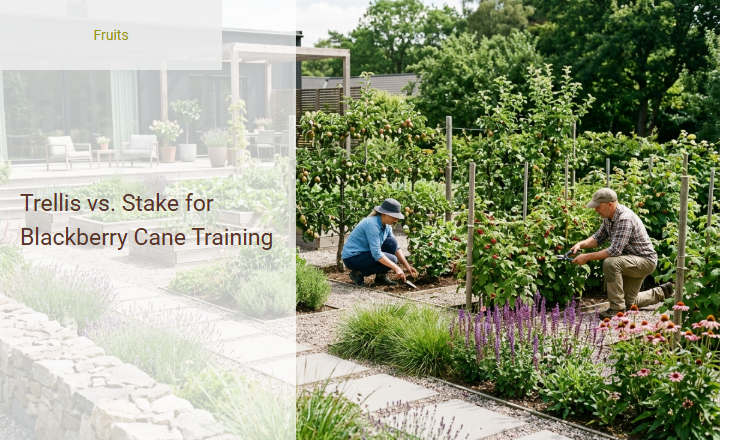
The physical layout of your garden plays a massive role in deciding which support structure to implement. Backyard gardeners with limited square footage often find that staking fits seamlessly into existing landscape designs. Because staked blackberries grow upright, they can be tucked into sunny corners, positioned along fences, or integrated into ornamental flower borders without dominating the space.
In contrast, large-scale backyard fruit patches or commercial operations lean heavily toward trellis systems. Trellises maximize efficiency by turning long stretches of land into organized, high-yielding rows. For growers who prioritize a clean, structured agricultural aesthetic, a long row of uniform trellised berries provides an attractive, orchard-like appearance. Conversely, those seeking a more relaxed, cottage-garden feel often prefer the discrete, low-profile nature of individual wooden stakes wrapped in green foliage, making the plant look more like a compact focal point rather than an industrial row crop.
Installation Guide and Cost Analysis
Before committing to a method, it is wise to calculate the budget, tools, and labor involved in setup. Building a trellis requires a moderate investment of time and money. You will need thick wooden end posts, intermediate metal T-posts, heavy-gauge wire, tensioning devices, and tools like a post-hole digger, wire cutters, and a hammer. While the initial setup cost is higher, the long-term durability of a well-built trellis means it will support your berry patch for a decade or more with minimal maintenance.
On the other hand, staking is incredibly economical and demands almost no specialized tools. A single metal T-post or pressure-treated wooden stake costs very little, and installation requires only a simple post driver or mallet. This makes staking the clear winner for gardeners on a tight budget or those looking for an immediate afternoon project. However, keep in mind that wooden stakes can rot over time and may need replacement every few years, which adds minor recurring costs and labor over the life of the plant.
Making Your Decision: The Final Verdict
Selecting the perfect support system comes down to matching your blackberry variety with your personal gardening goals. If you are growing trailing or semi-erect blackberries and want to achieve the maximum possible yield, investing the time and money into a permanent trellis is highly recommended. The structural support and ease of harvesting will pay dividends for seasons to come.
If you have limited space, are growing upright, erect varieties, or are working with a tight budget, the staking method is an excellent, highly practical choice. It keeps your garden tidy, requires minimal investment, and gets the job done without complex construction. By aligning your support strategy with your plants' growth habit and your own resource availability, you will set your garden up for years of sweet, abundant harvests.
| Feature | Trellis System | Stake System |
|---|---|---|
| Cane Compatibility | Ideal for trailing and semi-erect varieties. | Best for erect or individual semi-erect varieties. |
| Yield & Growth | Maximizes horizontal spread, sun exposure, and yield. | Constricts growth to a vertical clump; lower yield per plant. |
| Space Efficiency | Requires linear row space; high footprint. | Highly compact; ideal for small gardens and containers. |
| Setup Cost & Effort | Higher initial cost; requires posts, wire, and tensioners. | Minimal cost; simple wood/metal stake and soft ties. |
| Pruning & Harvest | Easy; canes are separated cleanly along wires. | Challenging; dense bunching makes inner canes hard to reach. |
Leave a comment