
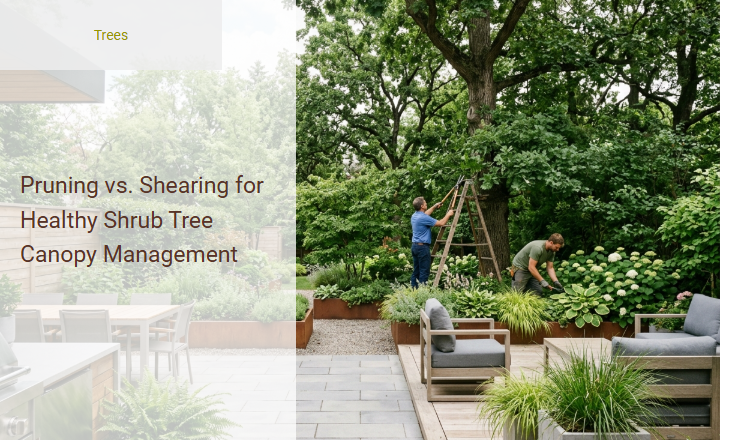
Property owners often struggle to maintain a manicured landscape without accidentally stalling the growth of their prized woody plants or causing unsightly dieback. Before grabbing the trimmers, it is vital to recognize that plant biology dictates how a canopy responds to physical cuts. Mastering the distinction between strategic pruning and aesthetic shearing grants your landscape optimal sunlight penetration, vigorous seasonal blooms, and long-term structural integrity.
However, we must stipulate that neither technique is a universal solution; applying the incorrect method can severely compromise plant health. For instance, selective hand-pruning on a delicate Hydrangea encourages vital interior airflow, whereas tight shearing on a formal Buxus (boxwood) hedge is reserved strictly for outer architectural shaping.
This article will demystify both practices, comparing their biological impacts, seasonal timing, and tool requirements to help you execute a professional canopy management strategy.
Demystifying Shrub and Tree Canopy Management
Maintaining a vibrant, beautiful landscape requires a deep understanding of how woody plants grow and respond to human intervention. Canopy management is not a one-size-fits-all chore; rather, it is a sophisticated practice of shaping and maintaining woody plants to ensure both aesthetic beauty and botanical vitality. Many homeowners and commercial landscapers often conflate two primary techniques: pruning and shearing. Choosing the right method is critical for long-term plant health, as a mistake can lead to structural weakness, disease susceptibility, or even the premature death of valued specimens.
Pruning is a highly targeted approach that respects the natural growth habit of a plant, while shearing focuses on creating clean, geometric surfaces. Understanding when, why, and how to apply these techniques is the foundation of successful arboriculture.
What is Pruning? The Science of Selective Cuts
The Botanical Purpose of Selective Removal
In arboriculture, pruning is defined as the selective removal of specific plant parts, such as branches, buds, or roots. This technique targets dead, diseased, damaged, or structurally weak limbs. By making precise cuts at strategic locations, you direct the plant's energy away from failing parts and toward healthy, productive tissues. This promotes natural growth habits and respects the biological blueprint of each species.
Pruning is fundamentally a therapeutic and preventative measure. When you remove a diseased limb, you stop the pathogen from traveling deeper into the trunk. When you eliminate crossing branches, you prevent bark rubbing, which can create open wounds. Through selective cutting, the plant's natural defense system can compartmentalize the wound efficiently, ensuring long-term survival and structural stability.
What is Shearing? The Art of Form and Symmetry
Sculpting the Outer Envelope
Shearing is the process of cutting back all shoots to a uniform plane, regardless of individual branch health or growth points. It is primarily an aesthetic tool used to create formal hedges, geometric shapes, and intricate topiary designs. Unlike pruning, which works within the inner canopy, shearing focuses strictly on the outer envelope of the plant, cutting indiscriminately across stems to achieve neat, flat surfaces and sharp symmetry.
This practice is highly effective for maintaining the formal lines of boxwoods, yews, and privets. However, it is crucial to recognize that shearing does not address the internal health of the plant. Because it encourages a dense layer of new growth right at the outer edge, it prioritizes man-made structure over the plant's natural growth habit, making it a stylistic choice rather than a biological benefit.
Plant Biology: Apical Dominance and Cut Responses
To manage canopies effectively, one must understand the biological mechanisms governing how plants grow. A central concept is apical dominance, where the terminal bud at the tip of a branch produces hormones (auxins) that suppress the growth of lateral buds below it. When you make a cut, you alter this hormonal balance, triggering different growth responses depending on the type of cut applied.
Shrubs and trees react to cutting methods in very distinct ways:
- Thinning Cuts: This pruning method removes an entire branch back to its point of origin or to a lateral branch large enough to assume dominance. It preserves apical dominance on remaining branches and allows the plant to maintain a natural form.
- Heading Cuts: This shearing and pruning method cuts the stem back to an indiscriminate point between nodes. Removing the terminal bud breaks apical dominance, causing multiple lateral buds just below the cut to activate and produce dense, bushy growth.
- Tree Responses: Trees rely heavily on strong central leaders. Constant heading cuts can destroy their structural architecture, leading to weak, co-dominant stems and hazard branches.
- Shrub Responses: Many shrubs tolerate heading cuts better than trees, but repeated shearing can still result in a congested outer shell that starves the interior branches of light.
Essential Tools for the Job: Hand Pruners vs. Hedge Shears
Selecting the correct tool is vital for executing clean cuts that heal quickly. Using inappropriate or dull equipment can crush stems, tear bark, and create jagged wounds that serve as open invitations for fungal pathogens and insect infestations. Different tools are designed for specific tasks, and understanding their applications protects plant health.
- Bypass pruners are the primary tool for pruning. They work like scissors, with a curved blade sliding past a flat hook, making clean, precise cuts on small living branches up to three-quarters of an inch in diameter.
- Loppers feature longer handles for increased leverage, allowing you to cut thicker branches up to two inches in diameter deep inside the canopy.
- Hand shears consist of long, straight blades designed specifically for shearing formal hedges, allowing you to trim many small shoots simultaneously to create a flat plane.
- Power trimmers are motorized tools used for rapid shearing of large, formal hedge lines, though they must be used carefully to avoid tearing woody stems.
Building Structural Integrity Through Pruning
Structural pruning is an investment in the future of young trees and large shrubs. By establishing a strong framework early in the plant's life, you reduce the need for corrective, drastic cuts later on. This proactive approach ensures that limbs are well-spaced along a single, strong central leader, preventing competing branches from compromising the tree's architecture.
Proper structural pruning eliminates co-dominant stems-situations where two branches of equal size compete for dominance-which significantly mitigates the risk of limb failure and splitting during severe wind, snow, or ice storms.
By choosing which branches remain and which are removed, you build a resilient canopy capable of distributing physical stress evenly. This ensures that the plant remains a safe, beautiful, and enduring asset to your landscape for decades.
Maximizing Sunlight Penetration and Air Circulation
A healthy canopy requires an environment where light and air can move freely through the interior branches. Selective pruning opens up the inner canopy, allowing sunlight to reach the lower and inner leaves, which keeps them photosynthetically active. Furthermore, improved air circulation allows wet foliage to dry quickly after rainfall, significantly reducing the risk of destructive fungal diseases like powdery mildew and leaf spot.
Conversely, constant shearing creates a different microclimate. Because shearing triggers rapid bud activation at the outer tips, it forms an incredibly dense, leafy shell. This outer shell blocks almost all sunlight and wind from entering the interior. Without light and air, the inner canopy becomes a stagnant zone of dead wood and bare branches, highly vulnerable to pests and disease outbreaks.
The Hidden Dangers of Constant Shearing
While a perfectly manicured, sheared hedge offers a formal aesthetic appeal, relying on shearing as the sole method of maintenance leads to severe biological degradation over time. Continuous shearing places plants under chronic stress and can lead to a slow decline in health.
- Severe inner-canopy leaf drop occurs because light cannot penetrate the dense outer shell, leaving the plant completely hollow on the inside.
- The accumulation of dead wood inside the plant increases, creating a highly flammable fuel load and an unattractive appearance if the outer layer is damaged.
- Pest susceptibility rises as insects find refuge in the warm, dry, and protected interior environment, shielded from natural predators and weather.
- Frequent shearing depletes the plant's energy reserves because it must constantly expend resources to produce new flush growth at the tips.
Timing Your Cuts: Seasonal Guidelines for Success
Timing is everything when it comes to canopy management. Pruning or shearing at the wrong time of year can disrupt natural growth cycles, sever developing flower buds, or leave plants exposed to winter damage. Understanding the seasonal requirements of your landscape plants is key to ensuring vibrant blooms and robust health.
| Plant Type | Best Timing | Management Goal |
|---|---|---|
| Deciduous Trees | Late Winter to Early Spring | Pruning during dormancy minimizes sap bleeding and disease transmission. |
| Spring-Blooming Shrubs | Immediately After Flowering | Prune before next year's flower buds set in the summer. |
| Summer-Blooming Shrubs | Late Winter or Early Spring | Pruning stimulates new wood growth where current-season flowers form. |
| Evergreen Hedges | Late Spring to Mid-Summer | Shearing during active growth allows new foliage to cover bare cuts quickly. |
Developing a Balanced Canopy Management Plan
A successful landscape does not rely on one single technique but instead integrates both pruning and shearing into a cohesive strategy. By understanding the biological needs and structural demands of each plant, you can design a maintenance routine that honors the plant's natural form while satisfying your aesthetic goals. Balancing these two approaches allows you to maintain neat, manicured spaces without sacrificing the ecological health of your green infrastructure.
To achieve this balance, reserve shearing exclusively for specific formal features, and use hand-pruning techniques on the rest of your trees and shrubs. Periodically thinning out the interior of sheared hedges will also allow light to penetrate, keeping the plants healthy from the inside out. Through thoughtful, biologically sound canopy management, your landscape will thrive with vigor, structural resilience, and enduring beauty for many years to come.
| Feature | Pruning | Shearing |
|---|---|---|
| Definition | Selective removal of specific branches to improve health and structure. | Non-selective cutting of outer twigs to create a uniform, flat surface. |
| Tools Used | Hand pruners, loppers, and pruning saws. | Manual hedge shears or motorized hedge trimmers. |
| Plant Health Impact | Improves airflow and light penetration; promotes internal strength. | Restricts light/air to interior; can cause deadwood and pest issues. |
| Growth & Shape | Maintains the natural, informal habit of the shrub. | Forces dense, compact outer growth; shapes into formal geometries. |
| Frequency | Infrequent (usually once per year or biennially). | Frequent (multiple times during the growing season). |
Leave a comment