
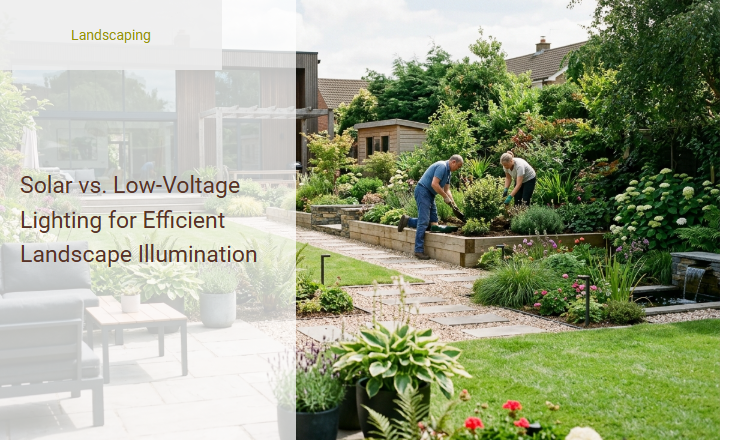
Homeowners often struggle to balance the desire for a beautifully illuminated exterior with the reality of soaring energy bills and complex installation demands. Before selecting fixtures, one must consider how modern landscape design increasingly fuses environmental responsibility with visual drama. Fortunately, choosing the right system grants you enhanced curb appeal and heightened security without draining your monthly budget.
To set realistic expectations, true efficiency is highly situational; a sun-drenched pathway in Arizona presents vastly different requirements than a heavily shaded garden in New England. For instance, while individual solar stakes excel at low-impact path marking, low-voltage LED spotlights remain unmatched for casting reliable, dramatic uplighting on mature oaks.
In this guide, we will conduct a rigorous comparison of solar and low-voltage systems-examining cost, illumination output, and durability-to help you engineer the perfect outdoor lighting scheme for your property.
Illuminating Your Outdoor Space: Solar vs. Low-Voltage
A beautifully designed outdoor space is incomplete without the transformative power of landscape lighting. Beyond merely extending the usability of your patio or garden into the evening hours, strategic exterior illumination enhances curb appeal, accentuates architectural features, and provides crucial security and safety by eliminating dark, vulnerable blind spots around your property. Homeowners looking to upgrade their outdoor environments generally face a classic dilemma: do you opt for the modern, wire-free convenience of solar fixtures, or do you invest in the robust, reliable performance of a low-voltage wired system?
Understanding Solar Landscape Lighting: Harnessing the Sun
Solar landscape lighting functions as a self-contained power plant for each individual fixture. These devices operate completely independently of the household electrical grid, capturing clean energy throughout the day and converting it into light when night falls. The mechanics rely on a few crucial, integrated components:
- Photovoltaic Cells: Microscopic solar panels, usually mounted on top of the fixture, that absorb sunlight and convert it into direct current (DC) electricity.
- Rechargeable Batteries: Built-in batteries (commonly NiMH or Lithium-ion) that store the generated electrical energy during daylight hours.
- LEDs (Light Emitting Diodes): High-efficiency light sources that consume minimal power while producing clear illumination.
- Photoresistors: Smart sensors that detect ambient light levels, automatically triggering the light to turn on at dusk and off at dawn.
The primary advantage of solar lighting is its complete autonomy. Because there are no wires to run or bury, installation is as simple as inserting a spike into the ground. This wire-free design means you can illuminate remote corners of your yard, far from any exterior power outlet, without hiring an electrician or digging up your lawn.
Demystifying Low-Voltage Lighting: Reliable Wired Power
Low-voltage landscape lighting relies on a centralized, wired architecture to deliver dependable illumination across your property. Unlike standard household fixtures that run on a high-voltage 120-volt (120V) current, a low-voltage system utilizes a specialized transformer plug connected to an outdoor GFCI outlet. This transformer safely steps down the household electrical current to a much safer 12-volt (12V) system, which is the standard for residential landscape lighting wiring.
The fundamental benefit of this setup is its absolute reliability. Because the fixtures receive direct, continuous power through physical copper cables, they are not dependent on weather conditions or daily sunlight exposure. A low-voltage system ensures that every single light fixture outputs a consistent, unwavering level of brightness from the moment you turn them on until they are shut off, regardless of how cloudy or stormy the day has been.
Energy Efficiency and Environmental Impact Comparison
Comparing the ecological footprints of these two systems reveals a balance between power source origins and manufacturing lifecycles. Solar lights operate on 100% renewable energy, consuming zero grid power. Modern low-voltage LED systems, while drawing from the grid, consume very minimal wattage compared to older halogen options. However, when evaluating the total environmental impact, the lifecycle of internal components must be considered.
Light Quality, Brightness, and Performance Control
When it comes to sheer illumination power, low-voltage systems significantly outperform solar alternatives. Measured in lumens, solar lights typically emit a soft, decorative glow ranging between 1 to 30 lumens. Because their output depends entirely on the previous day's sunlight, winter days or overcast weather will result in dim, short-lived light that fades quickly. They operate primarily on simple dusk-to-dawn sensors, offering little to no customization.
In contrast, low-voltage fixtures easily produce anywhere from 100 to over 1000 lumens per fixture, allowing for precise architectural spotlighting and safety path lighting. This power is governed by highly stable wattage and centralized controllers. Homeowners can program low-voltage systems using automated timers, astronomical clocks, or smart dimmers that integrate seamlessly with home automation setups, ensuring perfect light levels exactly when needed.
Installation Complexity and Safety Considerations
The process of setting up these two lighting systems represents polar opposites in terms of labor and skill requirements. Solar lighting offers unparalleled DIY simplicity, while low-voltage setups require a bit more planning but remain highly accessible to the average homeowner.
- Solar Installation: Unbox the fixtures, assemble the stakes, and push them into the soil where they will receive adequate sunlight.
- Low-Voltage Planning: Map out fixture placements, calculate total wattage, and select a transformer that can handle the load.
- Trenching and Wiring: Dig a shallow trench (usually 3 to 6 inches deep) along the designated run to bury the low-voltage cable.
- Connecting Fixtures: Attach the fixtures to the main run using quick-connect terminals, then plug the transformer into a safe outdoor GFCI outlet.
Safety-wise, the 12V current used in low-voltage systems is completely safe for children and pets. If a cable is accidentally severed by a garden spade, there is no risk of dangerous electrical shock, making both options highly secure for residential properties.
Longevity, Durability, and Maintenance Requirements
A landscape lighting system is an outdoor installation exposed to rain, snow, heat, and frost. The durability of your materials determines how long your investment will last. Solar lights, particularly budget-friendly options, are often constructed of lightweight plastics that can degrade under intense UV exposure, and their internal rechargeable batteries have a limited lifespan.
"Most solar light batteries must be replaced every 12 to 24 months to maintain charge capacity, and the solar panels themselves can become cloudy or scratched, permanently reducing their efficiency."
Low-voltage systems are engineered for long-term endurance. Fixtures are typically crafted from heavy-duty brass, copper, or cast aluminum, which naturally resist weathering. Maintenance for low-voltage setups is minimal: occasionally wiping down glass lenses, replacing an LED bulb after tens of thousands of hours of use, and ensuring the buried wires remain safely underground.
Cost Analysis: Upfront Investment vs. Long-Term Value
An honest evaluation of landscape lighting must weigh the immediate out-of-pocket expenses against the long-term value added to your home. Solar fixtures are incredibly inexpensive upfront, but they do not add measurable value to your property due to their temporary nature. Low-voltage systems represent a true home improvement investment that enhances property valuation.
| Factor | Solar Lighting | Low-Voltage Lighting |
|---|---|---|
| Initial Capital Cost | Very Low (typically $10–$30 per fixture) | Moderate to High (transformer, wiring, high-quality fixtures) |
| Installation Expense | Free (DIY) | Minimal DIY cost or professional installation fees |
| Lifespan | 1 to 3 years | 10 to 20+ years (with quality brass/copper fixtures) |
| Property Value Impact | Negligible | Adds permanent curb value and security appeal |
Designing Your Layout: Best Applications for Each System
To design an effective lighting scheme, you do not necessarily have to choose one system exclusively. Understanding where each excels allows you to create a beautiful, layered lighting plan. Solar lights are ideal for accentuating remote garden pathways, placing decorative markers around pool areas, or adding a soft glow to flower beds where running wires is impractical.
[Visual Layout: Highlighting structural house features with low-voltage spot lights while marking a winding back trail with soft solar posts]
Low-voltage systems excel at high-impact focal lighting. They are the premier choice for dramatic uplighting on mature trees, washing wide stone walls with warm light, and providing high-visibility illumination on driveways, architectural columns, and steps where consistent safety lighting is non-negotiable.
Choosing the Perfect Illumination Strategy for Your Home
Finding the ideal balance for your yard requires aligning your budget, DIY comfort level, and aesthetic goals. If you want a quick, affordable, and zero-effort way to add ambient charm to your garden beds, solar is your perfect match. If you seek professional-grade brightness, durable fixtures that survive the elements, and precise control over your home's nighttime curb appeal, low-voltage wired lighting is the superior choice.
Use this quick decision-making checklist to guide your final choice:
Choose Solar if: You want a fast DIY project, have excellent sun exposure, need to light remote zones, and prefer a soft decorative glow.
Choose Low-Voltage if: You want consistent year-round brightness, have shady areas, want to highlight architecture, and seek a permanent home value upgrade.
Choose a Hybrid Approach if: You want the reliability of low-voltage for main security areas and the flexibility of solar for distant flower beds.
| Feature | Solar Lighting | Low-Voltage Lighting (12V) |
|---|---|---|
| Power Source | Sunlight; integrated solar panels and rechargeable batteries. | Grid electricity; requires a 120V to 12V transformer. |
| Installation | Wireless; plug-and-play stake placement. | Requires trenching, burying cables, and mounting a transformer. |
| Brightness & Control | Low to moderate output; automatic dusk-to-dawn operation. | High, consistent output; supports dimmers, timers, and smart controls. |
| Reliability | Weather-dependent; dim or inactive on cloudy/winter days. | 100% reliable year-round; unaffected by weather or shade. |
| Upfront Cost | Very low; inexpensive fixtures with no additional components. | Moderate to high; costs include transformer, wiring, and fixtures. |
| Lifespan | Short (1–3 years); batteries degrade and plastic fixtures weather quickly. | Long (10+ years); durable metal fixtures with replaceable LED bulbs. |

Leave a comment