
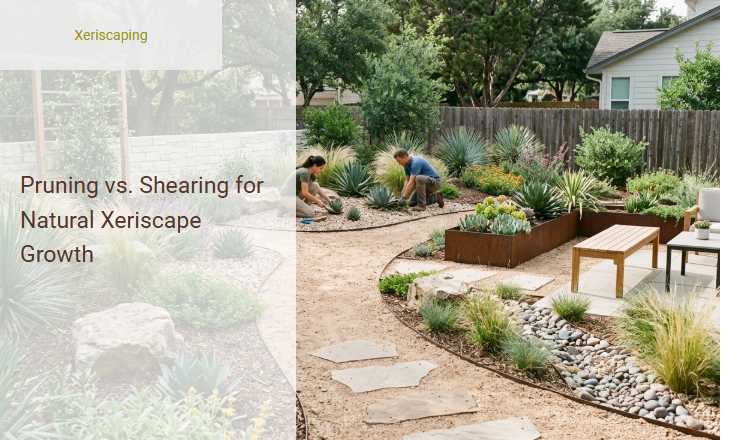
Homeowners and landscapers often struggle to maintain a clean, tidy aesthetic in arid gardens without stripping desert flora of its natural, rugged character. Traditional landscaping practices rely heavily on tight, manicured hedges, but applying these same methods to drought-tolerant species ignores their unique evolutionary biology.
Mastering the right shaping technique not only enhances the structural integrity of your garden but also yields richer seasonal blooms and slashes long-term maintenance costs. However, it is vital to understand that neither method is universally correct; rather, success lies in knowing how each technique affects plant physiology. For instance, while a hand-pruned Texas Sage (Leucophyllum frutescens) thrives with selective thinning, aggressive shearing often results in woody interiors and sparse foliage.
Below, we will analyze the key mechanical differences between pruning and shearing, explore species-specific guidelines, and outline a seasonal maintenance calendar to keep your xeriscape healthy, resilient, and visually striking.
Introduction: The Philosophy of Xeriscape Aesthetics
Xeriscape gardens celebrate the rugged, untamed beauty of arid regions. Unlike traditional formal landscapes that rely on sharp lines, symmetrical patterns, and manicured turf grass, a water-wise garden embraces the natural habit of drought-tolerant plants. This stylistic difference introduces a critical debate for homeowners and landscape professionals: pruning vs. shearing.
While formal gardening aims to impose human order over nature, xeriscaping seeks to partner with the environment. Traditional landscapes often force plants into boxy hedges, whereas xeriscape aesthetics focus on enhancing the innate architecture of desert flora. Deciding how to manage growth in these dry ecosystems is not just an aesthetic choice; it directly affects plant survival, resource use, and ecological balance.
Understanding Selective Pruning
Defining the Selective Approach
Selective pruning is the precise, intentional removal of specific plant parts, such as dead, diseased, or crossing branches. In the context of xeriscaping, this method works with the plant's natural growth habit rather than against it. Instead of blindly cutting back everything to a uniform length, gardeners select individual stems to shorten or remove entirely.
Target-Cut Techniques
To perform selective pruning, a gardener utilizes target-cut techniques, which involve making clean cuts just outside the branch collar or above a healthy, outward-facing bud. This encourages lateral growth in a desired direction and preserves the structural integrity of the specimen. By leaving the plant's core framework intact, light and air can penetrate deep into the canopy, minimizing pest issues and promoting long-term health.
The Mechanics of Shearing
Defining the Shearing Method
Shearing is the process of cutting back all the outer shoots of a plant to a uniform plane, regardless of individual branch structures. This method is predominantly utilized in formal European-style gardening to create sharp, geometric hedges, topiaries, or perfectly flat borders. Unlike selective pruning, shearing ignores the natural form of the plant, treating the living canopy as a singular, solid block of green.
Tools, Speed, and Plant Response
The mechanical differences between the two practices are vast. Pruning relies on hand-held bypass pruners or loppers to make individual cuts, which requires a slow, thoughtful pace. In contrast, shearing utilizes large hedge shears or gas-powered trimmers to slice through dozens of stems simultaneously in a fraction of the time. While this offers rapid aesthetic results, the biological response of the plant is severe. Shearing stimulates a flush of growth from dormant buds directly below the cut surface, resulting in a thick, artificial outer crust that starves the interior branches of sunlight.
Water Efficiency and Plant Health Dynamics
In arid climates, water is the most precious resource. Selective pruning helps conserve water by keeping a plant's biomass in balance with its natural root capacity. Removing dead wood and strategic branches allows the root system to easily support the remaining canopy, maintaining high water-use efficiency without triggering excessive new growth.
Shearing desert shrubs creates a physiological trap, forcing plants to expend limited moisture reserves on dense outer foliage that they cannot sustain during extreme drought.
When a shrub is sheared, the heavy cutting stimulates rapid, dense outer foliage. This thick outer layer of leaves has a high demand for water. Because the dense canopy blocks sunlight from reaching the interior branches, the interior leaves die off, leaving a hollow, woody skeleton covered by a thin, thirsty green shell. During hot summer months, this superficial foliage rapidly transpires moisture, putting immense strain on the root system and requiring more frequent irrigation to prevent dieback.
Ideal Xeriscape Species for Pruning
- Lavender (Lavandula species): Removing spent flower spikes and thinning out old wood allows air to circulate, preventing rot while maintaining a tidy, natural mound.
- Desert Willow (Chilopsis linearis): This small tree thrives when its lower branches are selectively pruned, showcasing its beautiful, weeping structure and orchid-like blossoms.
- Sage (Salvia and Leucophyllum species): Hand-pruning preserves the soft, silvery foliage and irregular, architectural branches, whereas shearing results in a woody, unproductive center.
- Agave and Yucca: These structural succulents must only be pruned by removing lower, dead leaves, keeping their sculptural shapes pristine and functional.
When Shearing is Acceptable in a Low-Water Garden
While selective pruning is generally preferred for plant health, there are specific, limited scenarios where shearing serves a practical purpose in a xeriscape. When managing certain ornamental grasses, such as deer grass or blue fescue, shearing back the entire plant close to the ground in late winter helps clear out dead thatch and stimulates fresh, vibrant spring growth. This reset mimics the natural grazing or fire cycles that these species adapted to over millennia.
Additionally, compact borders composed of small, highly resilient shrubs like dwarf myrtle can tolerate light shearing to maintain a clean edge along walkways or hardscapes. However, even in these situations, gardeners must balance this cosmetic shaping with occasional hand-thinning to ensure light still reaches the interior of the plant. Over time, excessive shearing will weaken even the hardiest border plants.
Step-by-Step Guide to Natural Pruning Techniques
- Select the right tools: Begin by gathering bypass hand pruners for small twigs, loppers for branches up to two inches thick, and a folding pruning saw for larger limbs. Ensure all blades are sharpened and sanitized.
- Identify the three Ds: Examine the shrub closely to locate any branches that are dead, damaged, or diseased, and remove these first to open up the plant.
- Evaluate crossing branches: Locate stems that rub against one another or grow inward toward the center, cutting them back to their origin to prevent structural damage.
- Apply the proper cut angle: Make clean, forty-five-degree cuts approximately one-quarter inch above an outward-facing bud, sloping away from the bud to shed water.
- Encourage directional growth: Step back frequently to assess the overall shape, ensuring that cuts redirect energy outward, maintaining a balanced, airy, and natural silhouette.
Long-Term Structural Benefits of Natural Growth
Allowing drought-tolerant plants to retain their natural form through careful pruning yields profound structural advantages. When branches grow naturally, they develop a balanced, strong framework capable of supporting their own weight. This open architecture allows wind to pass harmlessly through the canopy rather than catching the plant like a solid sail, which is a major cause of wind throw and branch breakage during desert storms.
Furthermore, plants with unhindered natural growth patterns maintain a healthy ratio between their root systems and foliage. Deep root systems develop in tandem with natural branch elongation, allowing the plant to tap into deep soil moisture during dry spells. Over time, this natural development extends the overall lifespan of the plant, producing resilient, self-sufficient specimens that require minimal human intervention.
Critical Maintenance Mistakes to Avoid
- Lion's tailing: Stripping all the inner foliage and leaving only tufts of leaves at the ends of branches, which makes limbs heavy, weak, and highly susceptible to sunburn and wind damage.
- Shearing native shrubs into globes: Forcing naturally irregular desert plants like creosote or Texas sage into perfect balls, which destroys their flowering potential and creates a dense outer shell of dead wood.
- Topping trees: Cutting the main leader branch of structural trees, which stimulates weak epicormic sprouts and permanently ruins the plant's structural integrity.
- Pruning during extreme heat: Cutting back plants during the hottest months of the summer, which exposes sensitive interior bark to intense ultraviolet rays and causes severe sunburn.
Conclusion: Nurturing a Resilient, Wild Landscape
Shifting away from the rigid, manicured ideals of traditional landscaping toward a more natural approach is a key step in successful xeriscaping. By prioritizing selective hand pruning over severe mechanical shearing, we preserve the botanical beauty and ecological function of drought-tolerant species. This mindful practice respects the innate growth habits of plants, allowing them to adapt naturally to challenging environmental conditions.
Choosing to work with nature rather than attempting to conquer it results in a garden that is both resilient and ecologically rich. A natural xeriscape provides food, shelter, and nesting sites for local wildlife, turning a water-wise yard into a thriving habitat. Embracing the organic forms of the desert leads to a deeply satisfying, biodiverse, and visually harmonious landscape that honors the true spirit of the arid West.
| Comparison Feature | Pruning | Shearing |
|---|---|---|
| Cutting Technique | Selective removal of individual, targeted branches. | Non-selective, uniform leveling of outer foliage. |
| Growth Response | Supports natural habit, structure, and internal branching. | Stimulates dense outer "shell" growth, depleting interior foliage. |
| Light & Airflow | Opens canopy to maximize interior sunlight and air circulation. | Blocks light and air, increasing disease risk inside canopy. |
| Plant Stress Level | Low; clean cuts at nodes facilitate rapid, natural healing. | High; multiple leaf-tip wounds lead to dieback and water loss. |
| Primary Application | Tree structural training, shrub rejuvenation, fruit production. | Formal hedges, topiary, and geometric landscape design. |
Leave a comment