
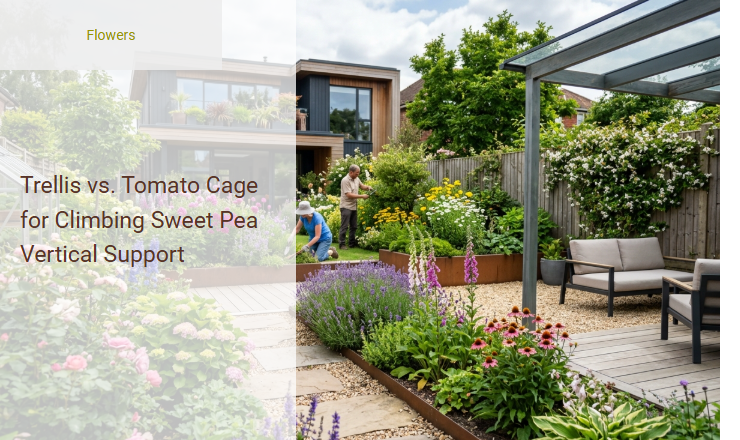
Home gardeners often struggle with floppy, tangled sweet pea vines that collapse under their own weight just as the peak blooming season begins. Before selecting a support structure, one must first understand how these annuals climb-specifically, their reliance on delicate, grasping tendrils that require thin mounting surfaces to secure upward growth. Mastering this vertical integration not only saves valuable garden footprint but also guarantees a dramatic, eye-level display of highly fragrant, long-stemmed blooms.
However, it is crucial to stipulate that while various structures are marketed as universal climbers, their physical geometry dictates entirely different horticultural outcomes. For instance, a fine-mesh nylon netting trellis offers vastly different anchoring opportunities than the thick, horizontal rings of a standard wire tomato cage. Below, we analyze both options across key metrics-including tendril grip, wind stability, and harvest accessibility-to help you choose the ultimate vertical support for your sweet peas.
Introduction: The Joy of Sweet Peas and the Need for Support
Few garden flowers capture the imagination quite like climbing sweet peas. Renowned for their delicate, ruffled blossoms and an enchanting, honey-and-orange-blossom scent that fills the spring air, these nostalgic annuals are a must-have for any cutting garden. However, to unlock their full blooming potential and keep their stems straight for harvesting, these vigorous climbers require sturdy, reliable vertical support. Without a proper structure to ascend, they quickly collapse into a tangled, moisture-trapping heap on the ground, leaving them susceptible to pests and disease. This necessity introduces a common debate among backyard growers: should you invest in a classic garden trellis, or can you get away with repurposing a budget-friendly tomato cage?
How Sweet Peas Climb: Understanding Tendrils
To choose the best support, it helps to understand the botany of how the sweet pea, or Lathyrus odoratus, climbs. Unlike twiners like pole beans that wrap their entire main stem around a pole, the sweet pea relies on a specialized, thread-like organ called a tendril. These highly sensitive, modified leaves lash out in the wind until they make contact with an object. Once they touch a suitable surface, the tendril quickly coils around it, securing the plant and pulling it upward. Because these climbing mechanisms are incredibly delicate and small, the thickness of your support structure matters immensely. If a support wire or wooden slat is too thick, the tiny grasp of the tendril cannot wrap around it, causing the plant to flop backward instead of climbing.
The Trellis: Classic Elegance and Generous Space
The trellis is the traditional choice for supporting sweet peas, offering both functional superiority and timeless aesthetic appeal. Available in various designs-ranging from rustic wooden ladders and ornate powder-coated metal frames to soft, flexible pea netting strung between t-posts-the trellis provides a flat, expansive surface that allows vines to spread out horizontally as they grow upward.
- Maximum Air Circulation: The flat, wide surface prevents crowding, reducing the risk of powdery mildew.
- Easy Harvesting: Flowers hang cleanly away from the foliage, making them simple to cut without damaging the plant.
- Optimal Tendril Grip: Most trellises use thin wire netting or slender wooden dowels that are the perfect diameter for sweet pea tendrils.
The Tomato Cage: Budget-Friendly and Accessible
If you have spare gardening gear lying around, the ubiquitous tomato cage is a highly accessible, budget-friendly alternative. These cylindrical wire structures are widely available at any hardware store and require virtually zero assembly or installation effort. While designed to support heavy, bushy tomato branches, their horizontal rings and vertical stays can also serve as a climbing frame for flowering vines.
- Pro: Low Cost and High Availability - Extremely inexpensive and easy to find in almost any garden center.
- Pro: Self-Supporting Design - Simply push the metal prongs directly into the soil or a container.
- Con: Slick, Thick Wires - The smooth metal of cheap cages can make it difficult for tendrils to find purchase.
- Con: Limited Climbing Surface - The narrow, tapering cylinder can cause sweet peas to bunch up and choke out their own light.
Direct Comparison: Climbing Ease and Grip
When comparing how easily sweet peas actually scale these two structures, the trellis is far superior to the slick, thick metal of a standard tomato cage. Sweet pea tendrils thrive on rough surfaces and thin profiles, such as jute twine or plastic netting. Standard metal tomato cages are often made of thick, coated wire that is too smooth and wide for the plant's delicate grips, meaning you will have to manually tie the vines to the cage using soft plant ties or add extra twine to create grip points. For a hands-off gardening experience where the plants climb naturally and effortlessly on their own, the trellis is the clear winner.
Visual Appeal: Aesthetic Integration in the Garden
Beyond utility, garden design plays a major role in choosing the right support. A beautifully crafted trellis elevates the entire garden space, acting as an architectural focal point even in the winter when the sweet peas have died back. In contrast, standard wire tomato cages are highly utilitarian and can look somewhat untidy or industrial in a formal flower bed.
"In a visual landscape, your support structures should act as a beautiful frame for your floral masterpieces, rather than a distraction from them."
Space and Scalability: Small Gardens vs. Large Borders
Your choice of support will depend heavily on your garden's layout and available space. If you are working with container gardening on a patio or balcony, a compact tomato cage fits perfectly inside a round pot, creating a tidy column of blooms. However, if you are planting a long, dramatic border or a dedicated cutting patch, trellising is much more scalable. Addressing your garden's unique spatial requirements is key; a linear trellis maximizes vertical space without taking up valuable ground real estate, allowing you to grow dozens of plants shoulder-to-shoulder, whereas multiple round tomato cages would quickly clutter a narrow path.
Step-by-Step: Setting Up a Trellis for Sweet Peas
Installing a trellis early in the season ensures your sweet peas have immediate support the moment their tendrils begin to stretch.
- Select a sunny location and securely anchor your trellis frame into the ground using wooden stakes or metal t-posts to prevent it from blowing over in strong winds.
- If using a bare wooden or metal frame, attach a layer of fine garden netting or string jute twine vertically and horizontally across the frame to create a grid with 2-to-3-inch openings.
- Plant your sweet pea seedlings approximately 4 to 6 inches apart directly along the base of the trellis.
- Gently guide the first young shoots toward the lowest wire or string, using a small piece of soft twine to loosely tie them in place until their natural tendrils take hold.
Hacking the Tomato Cage: Making It Work for Sweet Peas
If you prefer to use a tomato cage due to budget constraints or limited space, you can easily modify it to make it highly hospitable for sweet peas.
- Press the legs of the tomato cage firmly into the soil or into a large container filled with potting mix, ensuring it is perfectly stable.
- Take a roll of natural jute twine and wrap it tightly around the exterior of the cage, starting from the bottom and working your way to the top in a spiral pattern.
- Weave additional vertical strands of twine between the horizontal metal rings to create a grid-like mesh.
- Plant your sweet peas around the outside base of the cage, and push the young stems inward so they rest against the rough, easy-to-grip twine.
The Verdict: Which Support Wins for Sweet Peas?
While both options can successfully get your flowers off the ground, they serve different gardening styles. The tomato cage, especially when hacked with jute twine, is a fantastic, cheap solution for container gardening and casual backyards. However, for the longest stems, healthiest foliage, and most breathtaking garden display, the classic trellis remains the superior choice for growing sweet peas. Investing in a quality trellis pays dividends in straight stems, heavy flower production, and a beautiful garden aesthetic that you will enjoy all season long.
| Feature | Trellis | Tomato Cage |
|---|---|---|
| Vertical Limit | 6 to 8+ feet; accommodates full growth potential of sweet peas. | 3 to 5 feet; vines quickly stunt or flop over the top. |
| Tendril Grip | Excellent; fine netting, wire mesh, or thin wood offers instant grip. | Poor; thick metal rings require supplemental twine wrapping for grip. |
| Airflow & Harvest | Flat, 2D plane; optimal sunlight, low disease risk, easy stem cutting. | Dense, 3D cylinder; crowded foliage traps moisture, harder to harvest. |
Leave a comment