
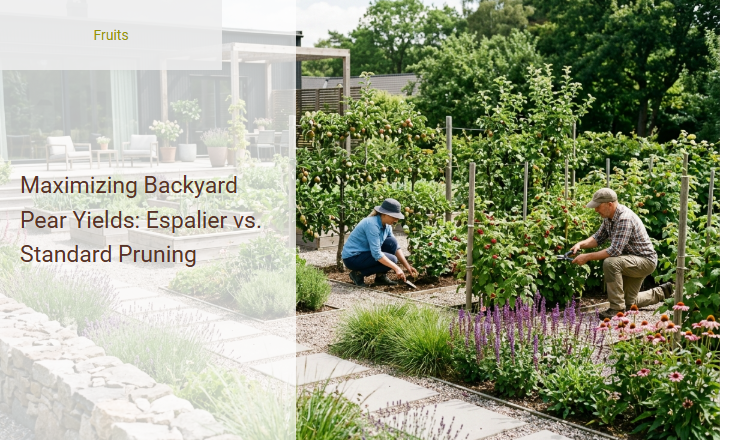
For many backyard orchardists, watching a prized pear tree produce sparse, hard-to-reach fruit after years of care is a deeply frustrating experience. Before deciding on a management strategy, one must first understand how canopy microclimates and light penetration directly dictate a tree's hormonal signals for fruit bud development. Implementing the right architectural training method grants growers the power to triple their harvest per square foot, transforming a simple garden layout into a highly productive asset.
However, optimal yields require acknowledging that success is highly dependent on cultivar-specific growth habits; a vigorous 'Bartlett' reacts differently to training than a slow-growing 'D'Anjou'. For instance, training a 'Conference' pear onto a multi-tier horizontal espalier trellis maximizes solar interception far better than a standard open-center canopy. Below, we will compare the spatial efficiency, maintenance demands, and yield profiles of espalier systems against traditional standard pruning to help you choose the best framework for your orchard.
Introduction: The Quest for the Perfect Backyard Pear Harvest
For home gardeners, the journey to a bountiful orchard begins with a critical choice in structural design. Cultivating backyard pear trees requires a balance between biological health and spatial harmony. The two primary paths to achieving this balance are espalier pruning and standard pruning. Each method shapes the growth, alters the aesthetic, and dictates the overall fruit yield of your trees in distinct ways.
While standard pruning honors the majestic, full-bodied growth patterns of traditional orchards, the ancient art of espalier forces branches into a flat, two-dimensional plane. Choosing between these methods transforms your landscape, turning your pear trees either into natural shade-giving centerpieces or highly structured, living architectural features that maximize garden aesthetics.
Demystifying Standard Pruning: The Traditional Approach
Standard pruning is the classic method of orchard training. It allows a pear tree to fulfill its natural genetic potential, growing upward and outward to form a three-dimensional canopy. This approach works with the tree's natural apical dominance, guiding vegetative growth into a shape that can support heavy fruit loads while maintaining structural integrity.
To keep standard trees productive and accessible, growers typically rely on one of two foundational training systems:
- Central-Leader System: A dominant central trunk forms the vertical axis, with tiers of lateral branches spacing out as they ascend, creating a pyramidal shape ideal for European pear varieties.
- Open-Center (Vase) System: The central leader is removed, encouraging three to five primary scaffold branches to spread outward. This creates an open middle that allows light to reach the inner canopy, which is highly beneficial for Asian pear varieties.
The Espalier Technique: Art Meets Fruit Production
Dating back to ancient Roman times and perfected in the walled gardens of medieval Europe, the espalier technique is the practice of training woody plants flat against a support structure. By securing young, flexible branches to a wooden trellis, wire system, or brick wall, gardeners direct the tree's energy horizontally rather than vertically.
This method exploits the pear tree's natural spur-bearing fruiting habit. By bending branches horizontally, vegetative growth slows down, and the production of fruiting spurs increases along the entire length of the horizontal tiers. This results in a highly decorative pattern that maximizes yield along a single vertical plane.
Space Optimization: Footprint and Garden Integration
When selecting a training system, space is often the deciding factor. Standard pear trees, even on semi-dwarf rootstocks, require a circular footprint of 12 to 15 feet in diameter. This expansive three-dimensional growth limits their use in tight residential zones, making them better suited for sprawling suburban gardens where they can serve as standalone features.
In contrast, an espaliered pear tree occupies almost no ground depth. Because it is trained flat, it can thrive in a planting bed only 12 to 18 inches wide. It is designed to hug existing structures, transforming bare surfaces into productive green spaces.
"Espalier bridges the gap between urban density and agricultural self-sufficiency, turning boundary walls and narrow walkways into highly productive, vertical micro-orchards."
Sunlight Penetration and Photosynthesis Efficiency
Sunlight is the primary engine behind fruit development, directly driving sugar production and bud differentiation. In a standard tree canopy, light penetration decreases dramatically as it moves inward. The outer leaves shade the inner layers, leaving a significant portion of the tree's interior unproductive and prone to generating low-quality fruit.
The thin profile of an espalier system changes this dynamic entirely. Because the canopy is only one branch thick, every leaf has direct access to intercepted light. This maximizes photosynthetic active radiation across the entire tree, ensuring that all available energy goes straight into sugar accumulation. This process results in larger, sweeter pears that ripen evenly.
Yield Comparison: Quality versus Quantity
While standard trees produce a larger overall volume of fruit due to their sheer biomass, espalier systems excel in individual fruit quality. The trade-off is straightforward: standard trees offer bulk harvests with varying quality, while espaliered trees provide a curated harvest of premium fruit.
A closer look at the yield dynamics reveals the distinct advantages of each method:
| Metric | Standard Pruning | Espalier Pruning |
|---|---|---|
| Total Yield Volume | High (up to several bushels per tree) | Moderate (restricted by structure size) |
| Individual Fruit Size | Variable (smaller in shaded interior) | Consistently Large (uniform light access) |
| Sugar Content & Sweetness | Moderate to Good | Excellent (high brix level from sun exposure) |
| Harvest Accessibility | Difficult (requires ladders/fruit pickers) | Effortless (all fruit within arm's reach) |
Pest and Disease Management: Prevention and Access
Pear trees are susceptible to several pathogens and pests, most notably pear scab, fire blight, and codling moths. Managing these issues depends heavily on the structure of the tree. A standard pear tree's dense canopy traps moisture, creating a high-humidity microclimate that encourages fungal spores to germinate. Spraying organic controls or inspecting inner branches for early signs of disease in a large tree can be challenging.
The open, two-dimensional design of an espalier tree offers a natural defense. Air flows freely through the flat branch structure, drying leaves quickly after rain and reducing the damp conditions that promote scab and blight. Additionally, because every branch is fully visible, gardeners can spot pest activity immediately and apply targeted treatments easily without specialized spraying equipment.
Labor, Tools, and the Learning Curve
Maintaining a pear tree requires an investment of time and attention. Standard pruning is less demanding on a weekly basis, typically requiring just one major session of winter pruning and optional summer thinning. It relies on standard bypass loppers, hand pruners, and a sturdy orchard ladder.
Espalier training demands a more disciplined approach and a higher level of patience. While the tools remain simple-requiring only sharp hand shears and soft training ties-the gardener must commit to active management throughout the growing season to maintain the structural form.
- Winter Pruning: Cut back lateral shoots to three buds to encourage the formation of fruiting spurs along the main arms.
- Spring Training: Tie down new, green shoots to the wire support system before they woodify and harden.
- Summer Pruning: Cut back vigorous upright water sprouts to direct the tree's energy into fruit development rather than leafy growth.
- Fall Structural Check: Inspect ties to ensure they are not girdling the expanding bark, and reinforce any loose support wires.
Best Pear Cultivars for Espalier and Standard Growth
Selecting the right variety is crucial, as some cultivars naturally adapt to structured training, while others thrive when allowed to grow freely.
- Conference (European Pear)
- Highly recommended for espalier. It is self-fertile, reliable, and produces elongated fruit that benefits from the warmth of a south-facing wall.
- Hosui (Asian Pear)
- Excellent for both standard open-center pruning and horizontal espalier systems. Its vigorous growth requires regular summer pruning to maintain structure.
- Williams' Bon Chrétien / Bartlett (European Pear)
- An iconic pear that performs beautifully under standard central-leader training, developing a sturdy, balanced canopy that supports heavy yields.
- Shinko (Asian Pear)
- Highly resistant to fire blight, making it a great candidate for standard pruning systems in regions where warm, humid climates complicate disease control.
Making the Choice: Your Backyard Pear Strategy
Choosing between espalier and standard pruning comes down to assessing your garden's layout, your design goals, and the amount of time you can dedicate to maintenance. If you want a classic, low-maintenance shade tree with abundant harvests, standard pruning is the natural choice. If you are working with limited space and want to combine gardening with architectural design, the espalier method offers an elegant, highly productive solution.
| Comparison Feature | Espalier Pruning | Standard Pruning |
|---|---|---|
| Space & Footprint | Two-dimensional; grows flat against walls, fences, or trellises. | Three-dimensional; requires a large, circular ground footprint. |
| Structural Support | Mandatory; requires permanent wire, wood, or metal framework. | None; tree relies entirely on its self-supporting trunk. |
| Pruning Frequency | High; requires both summer (shaping) and winter (structural) pruning. | Low to moderate; primarily pruned once during winter dormancy. |
| Microclimate & Disease | Maximizes sun exposure and airflow; significantly lowers fungal risk. | Canopy interior shades itself; requires thinning to prevent disease. |
| Harvest & Yield | Easy, ladder-free harvest; produces fewer, but larger, higher-quality pears. | Requires ladders; produces a higher volume of variable-sized pears. |
Leave a comment