
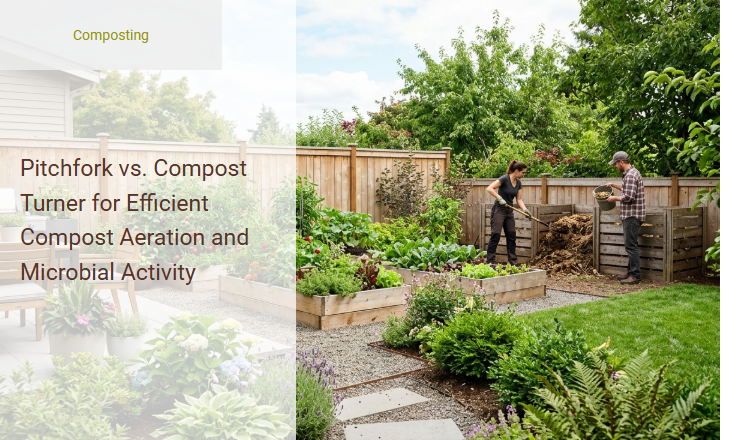
Maintaining an active, high-temperature compost pile often feels like an endless cycle of backbreaking labor, leaving many growers frustrated by stagnant decomposition and unpleasant odors. To address this struggle, we must first understand the biological engine of the pile: aerobic microbes require a continuous, uninterrupted supply of oxygen to efficiently break down organic waste.
Optimizing this airflow grants you rich, nutrient-dense humus in a fraction of the time, directly boosting your soil's vitality. However, achieving maximum efficiency is highly situational; a tool that excels in a small-scale garden setup can become highly impractical when applied to larger operations.
For example, while a heavy-duty hand pitchfork offers excellent precision for turning compact backyard bins, a mechanical compost turner is indispensable for aerating massive farm windrows. This analysis compares both tools, examining their impact on microbial kinetics, labor allocation, and thermal retention to help you select the ideal aeration strategy for your specific site.
Introduction: The Battle for Better Compost Aeration
Oxygen is the lifeblood of organic decomposition. Without it, a pile stagnates, slow-burning carbon instead of converting it into rich, fertile soil. At the heart of this transformation is the battle for optimal airflow. Gardeners often find themselves divided over the best tool for the job. Do you rely on the tried-and-true classic, the traditional pitchfork, to manually stir the organic heap? Or do you invest in a specialized compost turner designed to scientifically maximize microbial activity? Understanding how these tools affect your heap is the key to mastering soil chemistry.
The Biological Engine: How Aeration Drives Microbial Activity
Composting is not merely a decay process; it is a complex biological ecosystem powered by aerobic microorganisms. These bacteria and fungi require a steady stream of oxygen to digest carbon and nitrogen source materials efficiently. When oxygen levels drop below five percent, these beneficial microbes suffocate and die. In their place, anaerobic bacteria take over, leading to putrefaction, toxic fermentation, and foul-smelling gases like hydrogen sulfide. Regular aeration ensures that aerobic respiration remains dominant, maintaining high temperatures and producing a sweet, earthy-smelling end product.
The Traditional Approach: Pitchforks in the Compost Pile
For generations, the pitchfork has been the primary tool in the backyard composter's arsenal. Its long, sharp tines easily pierce compacted organic matter, allowing users to lift, shake, and redistribute heavy piles. Manual lifting provides a tactile connection to the pile, helping gardeners feel spots that are too dry, too wet, or overly compacted.
- Lifting and separating matted grass clippings and wet leaves to prevent clumping.
- Creating natural ventilation chimneys through manual fluffing and lifting.
- Providing unmatched structural flexibility, allowing you to turn piles of any shape or size without equipment constraints.
Mechanical Precision: How Compost Turners Work
In contrast to manual lifting, mechanical compost turners leverage physical design to optimize the breakdown of organic waste. Whether using a tumbling drum or a handheld aerator probe, these tools systematically homogenize the pile with minimal physical stress on the operator.
- The organic waste is loaded into a drum or penetrated deeply by an aerator probe.
- Mechanical rotation or physical agitation lifts materials from the bottom and drops them through the air column.
- Clumps are shredded and blended, increasing the overall surface area exposed to oxygen.
- Fresh air is systematically drawn into the core of the mixture as it settles back down.
Efficiency Breakdown: Time, Effort, and Scale
To help you choose the right approach, here is a direct comparison of how each tool performs across essential metrics.
| Metric | Pitchfork | Compost Turner |
|---|---|---|
| Physical Labor | High; requires significant lifting and bending | Low to Moderate; relies on leverage or rotation |
| Processing Speed | Slower; dependent on manual energy and stamina | Fast; processes large batches in minutes |
| Maximum Managed Volume | Small piles (under 1 cubic yard) | Medium to Large piles and continuous bins |
Microbial Disruption vs. Preservation: The Pitchfork Effect
The Integrity of Fungal Networks
Manual turning with a pitchfork is a relatively gentle process. Because it does not violently shred the materials, it helps preserve delicate fungal hyphae. These microscopic fungal threads are essential for breaking down tough, woody lignins and building complex, stable soil structures over time.
Sustaining Localized Thermal Zones
Pitchfork turning also leaves parts of the pile intact, preserving localized hot spots where thermophilic microbes thrive. This uneven turning allows different microbial communities to coexist in different zones of the heap, boosting overall biological diversity in the finished compost.
Accelerated Colonization: The Compost Turner Effect
Homogeneous Blending for Bacterial Domination
Compost turners excel at creating a highly uniform environment. By completely blending greens and browns, these devices ensure that beneficial bacteria have direct, immediate contact with food sources, resulting in rapid colonization and faster decomposition.
Achieving the Perfect Thermophilic Phase
Uniform distribution of moisture and oxygen triggers a massive, synchronized spike in heat. This consistent thermophilic phase destroys weed seeds and pathogens quickly, yielding a clean, sanitized compost in a fraction of the time required by manual methods.
Cost, Maintenance, and Tool Lifespan
A high-quality pitchfork made of forged steel and solid ash wood represents a minimal initial investment. It has no moving parts to break, requires virtually no maintenance beyond a quick rinse, and can easily last for decades. On the other hand, specialized compost turners-especially mechanical tumblers or geared hand tools-carry a higher upfront cost. They feature seals, hinges, and bearings that can rust, wear out, or fail under heavy loads, necessitating regular lubrication and parts replacement over time.
Matching the Tool to Your Composting Scale
Selecting the perfect tool depends largely on your physical space, strength, and composting goals. To find your ideal match, ask yourself the following diagnostic questions:
- Is your compost pile smaller than one cubic yard, or do you utilize small, open bins?
- Do you have physical limitations, such as back pain, that make heavy lifting difficult?
- Are you processing large quantities of tough carbon materials like branches and wood chips that require active shredding?
The Final Verdict: Optimizing Soil Biology
The decision to use a traditional pitchfork or a modern compost turner hinges on what you value most for your garden. The pitchfork excels at preserving delicate fungal structures and maintaining localized microbial diversity, ideal for creating rich humus for perennials and trees. The compost turner prioritizes speed, high temperatures, and high-volume throughput, making it perfect for rapid turnaround of vegetable garden feedstocks. By matching your aeration tool to your organic waste volume and physical capacity, you ensure a healthy, active heap that delivers optimal nutrient density and robust microbial life to your living soil.
| Aeration Metric | Pitchfork (Manual) | Compost Turner (Mechanical) |
|---|---|---|
| Optimal Pile Scale | Small-scale (under 1.5 m³ / backyard bins) | Large-scale (windrows, farm, commercial) |
| Aeration Speed | Slow (30–60 minutes per cubic meter) | Rapid (seconds per cubic meter via rotation) |
| Labor & Energy | High physical exertion; manual lifting | Minimal physical labor; engine or tractor-driven |
Leave a comment