
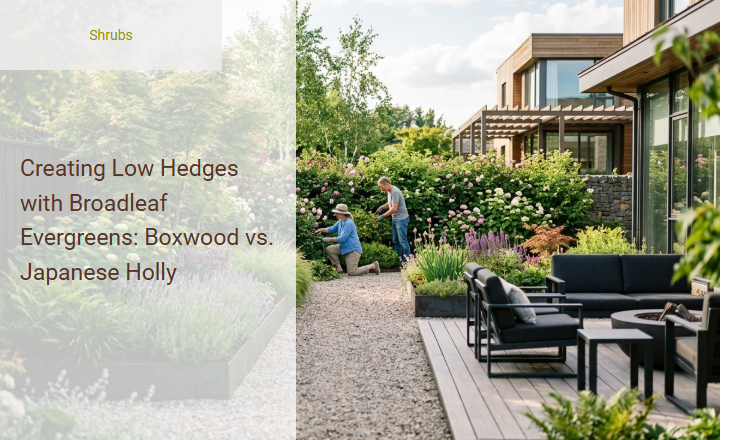
Designing a pristine, low-growing garden border can be surprisingly frustrating. Many homeowners struggle to find compact shrubs that maintain their tidy structure year-round without requiring constant, tedious pruning or falling victim to devastating pests and diseases.
In classical landscape design, formal borders have long relied on hardy woody plants to define pathways and frame garden beds. Selecting the right broadleaf evergreen grants your property effortless architectural elegance and permanent, four-season curb appeal. However, achieving this polished look requires a crucial stipulation: you must match the specific drainage, soil, and sunlight conditions of your site to the unique biology of the plant.
To illustrate this, we examine two premier candidates for low-boundary design: classic Boxwood (Buxus) and the highly resilient Japanese Holly (Ilex crenata). Below, we will compare their growth habits, maintenance demands, and environmental tolerances to help you select the ideal species for your landscape.
Introduction to Low Evergreen Hedges
Creating a defined border in your garden requires plants that maintain their structure throughout the year. Broadleaf evergreens are the perfect choice for low hedges, offering year-round structure, lush green tones, and a neat appearance that frames walkways and garden beds beautifully.
For generations, Boxwood has reigned as the classic choice for formal English-style gardens, prized for its tight growth and heritage look. However, Japanese Holly has emerged as an incredibly popular alternative, offering a remarkably similar appearance with its own unique set of cultivation advantages.
Visual Comparison: Leaves and Texture
At first glance, these two shrubs look nearly identical, but a closer examination reveals distinct differences in leaf structure and overall texture that can change the character of your low hedge.
- Boxwood (Buxus): Features opposite, oval-shaped leaves that have a smooth margin and a distinct, tiny notch at the very tip. The leaves possess a slightly leathery feel and a glossy, deep green finish that reflects light.
- Japanese Holly (Ilex crenata): Displays alternate, obovate leaves with finely serrated or scalloped edges. The texture is slightly thinner than boxwood, and the foliage typically has a dark, lustrous green color that produces a slightly softer texture when viewed from a distance.
When planted as a low hedge, boxwood creates a highly structured, rigid, and classic appearance, while Japanese Holly offers a subtly looser, cloud-like texture that blends beautifully into modern and semi-formal landscapes.
Growth Rates and Maintenance Demands
The speed at which your hedge grows directly impacts how often you will need to prune it to maintain a clean, low-profile border. A faster-growing plant fills in quickly but demands more regular labor.
| Feature | Boxwood (Buxus) | Japanese Holly (Ilex crenata) |
|---|---|---|
| Growth Rate | Slow (3 to 6 inches per year) | Moderate to Fast (6 to 12 inches per year) |
| Pruning Frequency | Once per year | Two to three times per year |
| Maintenance Level | Low to Moderate | Moderate to High |
Because Japanese Holly grows at a faster rate, it requires more frequent shearing throughout the growing season to keep its neat, low-growing shape. Boxwood retains its manicured form for months with minimal intervention.
Soil, Moisture, and pH Preferences
Underground conditions play a major role in the health and vitality of your hedge. Boxwood and Japanese Holly have distinct preferences when it comes to soil chemistry and moisture levels they need to thrive.
Boxwoods prefer neutral to slightly alkaline soil (pH 6.5 to 7.5) and absolutely require excellent drainage, as their shallow root systems are highly susceptible to root rot in waterlogged conditions.
On the other hand, Japanese Holly thrives in acidic, moist, well-draining soil (pH 5.0 to 6.0). If planted in alkaline soil, Japanese Holly often suffers from chlorosis, a condition where the leaves turn yellow due to nutrient deficiencies.
Sunlight Requirements and Tolerance
Both of these evergreen shrubs are relatively versatile when it comes to light exposure, but sunlight directly influences their growth density and winter appearance.
Boxwood grows exceptionally well in partial shade to full sun. In hot climates, afternoon shade is highly beneficial to prevent leaf scorching. Too much deep shade can cause boxwood foliage to thin out over time.
Japanese Holly tolerates full sun to partial shade with ease. However, when grown in full sun, it develops its densest foliage, making it easier to maintain as a tight, solid hedge. In cold climates, winter sun combined with harsh winds can cause winter burn on both species, but adequate watering before the ground freezes helps mitigate this risk.
Climate Resilience and USDA Hardiness
Before selecting your hedge plant, it is essential to understand how well they tolerate cold winters and hot summers in your specific geographic region.
Boxwood varieties, particularly English and Korean hybrids, are generally hardy in USDA zones 5 through 9. They have excellent cold tolerance, though they can suffer from winter bronzing-a temporary copper-brown discoloration caused by freezing winds and winter sun.
Japanese Holly is typically hardy in USDA zones 5 through 8. It handles summer heat and humidity better than many boxwood varieties, making it an excellent choice for warm southern climates, although it is slightly less tolerant of extreme northern winter winds.
Pests, Diseases, and Vulnerabilities
Protecting your hedge from biological threats is crucial for preserving its clean look. Each shrub faces specific susceptibilities that you must monitor regularly.
- Boxwood Blight: A devastating fungal disease that causes rapid defoliation and dark cankers on the stems.
- Boxwood Leafminer: The larvae of this tiny fly feed inside the leaves, causing blistering and yellowing.
- Spider Mites: These tiny pests affect Japanese Holly in dry, hot conditions, sucking sap and leaving behind a dusty, speckled appearance on the foliage.
- Root Rot: Both plants can suffer from Phytophthora root rot if planted in heavy, poorly drained clay soils.
Pruning and Shaping Best Practices
Keeping a low hedge looking crisp and healthy requires proper technique and timing during the pruning process.
- Prune in late spring or early summer after the initial flush of new growth has hardened off.
- Use sharp, sanitized hand shears to make clean cuts, preventing open wounds that invite disease.
- Shape the hedge so the base is slightly wider than the top, allowing sunlight to reach the lower branches and preventing bottom thinning.
- Remove dead, damaged, or diseased wood from the interior of the shrub to improve air circulation.
Avoid shearing late in the autumn season, as this stimulates tender new growth that will easily get damaged by freezing winter temperatures.
Cost, Availability, and Longevity
Budget and long-term planning are key factors when installing a new landscape feature. The initial investment and the life expectancy of your plants can vary significantly.
Boxwood plants are widely available but tend to be more expensive upfront due to their slow growth rate in nurseries. However, boxwoods are incredibly long-lived plants, often surviving for decades or even centuries when properly maintained.
Japanese Holly is typically more affordable and readily available in large quantities because it grows faster in production environments. While it is a durable plant, its overall lifespan is generally shorter than that of boxwood, meaning it may require replacement sooner.
Final Verdict: Which Shrub is Right for Your Garden?
Your choice depends on your local environment, budget, and maintenance preferences. If you desire a classic, formal hedge with slow growth that only requires once-a-year shearing, Boxwood is the superior choice. If you have acidic soil, want a faster-growing border that fits a tighter budget, and do not mind regular pruning, Japanese Holly is the ideal candidate.
| Feature | Boxwood (Buxus) | Japanese Holly (Ilex crenata) |
|---|---|---|
| Growth Rate | Slow; requires infrequent pruning to maintain low height. | Moderate to fast; requires frequent shearing to stay compact. |
| Soil pH Preference | Neutral to slightly alkaline (pH 6.5–7.5). | Acidic (pH 5.0–6.0); leaves yellow in alkaline soil. |
| Pest & Disease Risk | High risk: Susceptible to devastating Boxwood Blight and Leafminers. | Low risk: Immune to Boxwood Blight; susceptible to Spider Mites. |
| Foliage & Aroma | Opposite leaf arrangement; distinct, sometimes pungent scent. | Alternate leaf arrangement; odorless. |
| Regeneration | Recovers well from hard pruning into old wood. | Poor recovery if cut back to old, leafless woody stems. |
Leave a comment