
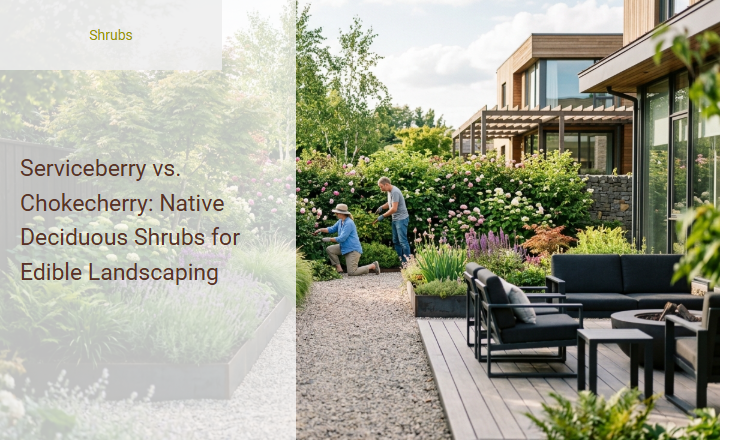
Designing a high-yield edible landscape often presents a frustrating challenge: balancing ornamental beauty with reliable, low-maintenance food production. Many landowners struggle with traditional fruit trees that demand intensive pruning, chemical treatments, and specific soil conditions to thrive.
To overcome this, we must first look to the ecological resilience of native species. Integrating native deciduous shrubs into your design grants you a self-sustaining landscape that naturally resists local pests while offering stunning multi-season visual appeal. Among the top contenders for this dual role are serviceberries and chokecherries.
However, a successful harvest requires matching each plant's specific physiological needs to your site. For instance, while the Saskatoon Serviceberry (Amelanchier alnifolia) produces sweet, blueberry-like fruit in well-drained soils, the hardy Chokecherry (Prunus virginiana) yields tart, astringent drupes best suited for preserves and tolerates much wetter, marginal ground.
This article compares these two powerhouses across key categories-including growth habits, soil tolerances, and culinary applications-to help you select the ideal shrub for your property.
Introduction: The Rise of Edible Native Landscaping
In recent years, home gardening has undergone a revolutionary shift. Homeowners are no longer satisfied with purely ornamental lawns; instead, they are embracing edible landscaping-the practice of integrating food-producing plants into beautiful, functional garden designs. This approach marries aesthetics with food security and ecological responsibility. By choosing native species, gardeners can create resilient ecosystems that require fewer resources while yielding delicious harvests.
Among the most versatile and productive choices for North American yards are the Serviceberry (genus Amelanchier) and the Chokecherry (Prunus virginiana). These two premier native deciduous shrubs offer spectacular year-round beauty, require minimal fuss once established, and produce abundant crops of berries that feed both humans and local wildlife. Understanding their unique traits is the first step toward transforming your yard into a sustainable, edible paradise.
Botanical Profiles: Understanding the Contenders
Before planting, it is essential to understand the genetic background and natural growth habits of these outstanding native woody plants.
Serviceberry (Amelanchier species)
Also known as shadbush, juneberry, or saskatoon, the Serviceberry belongs to the Rosaceae (Rose) family. It has a widespread native range stretching across most of temperate North America.
- Scientific Classification: Amelanchier spp. (commonly A. alnifolia, A. arborea, or A. laevis).
- Native Range: Coast to coast across Canada and the United States.
- Growth Habit: Multi-stemmed shrub or small understory tree with an elegant, upright, vase-shaped form.
- Mature Size: Typically ranges from 10 to 25 feet tall, depending on the specific species and cultivar.
Chokecherry (Prunus virginiana)
The Chokecherry is a robust and hardy suckering shrub that also belongs to the Rosaceae family. It is renowned for its adaptability to harsh climates.
- Scientific Classification: Prunus virginiana.
- Native Range: Most of North America, extending from Newfoundland to British Columbia, and south into the United States.
- Growth Habit: Dense, suckering shrub or small, round-headed tree that often forms thickets.
- Mature Size: Generally reaches 15 to 30 feet tall, with a spread of 10 to 20 feet.
Four-Season Appeal: Blooms, Foliage, and Fall Color
Both shrubs are outstanding ornamental performers, ensuring that your edible landscape remains visually stunning throughout every season of the year.
Spring Splendor
In early spring, Serviceberry is one of the first plants to bloom, bursting into cloud-like clusters of delicate, star-shaped white flowers just as the leaves emerge. Chokecherry follows shortly after, producing dense, cylindrical, drooping racemes of fragrant white blossoms that drape elegantly from the branches.
Summer Lushness
During the summer months, Serviceberry features finely-toothed, oval-shaped leaves of a soft blue-green color. In contrast, Chokecherry boasts glossy, deep green, elliptic foliage that provides a rich, dense canopy of shade.
Autumn Drama and Winter Structure
When autumn arrives, Serviceberry lights up the garden with a brilliant display of vibrant orange, red, and golden-yellow foliage. Chokecherry transitions to warm hues of copper, yellow, and deep orange. In winter, the smooth, silvery-grey bark of the Serviceberry and the dark, textured bark of the Chokecherry offer striking silhouettes against the snow.
Flavor Profiles and Harvest Windows
While both shrubs produce small, dark, berry-like pomes or drupes, their flavors and harvest times differ significantly. Serviceberries are sweet and mild, often compared to high-quality blueberries with a subtle almond undertone due to their small, edible seeds. They ripen early in the summer, typically in June or early July.
Chokecherries, on the other hand, are highly astringent when eaten raw due to their high concentration of tannins. When cooked, this dry pucker transforms into a deep, rich, and complex cherry flavor. They mature much later in the season, typically from late August through September.
| Feature | Serviceberry (Amelanchier) | Chokecherry (Prunus virginiana) |
|---|---|---|
| Fruit Type | Small pome (similar to a tiny apple) | True drupe (stone fruit with a central pit) |
| Flavor Profile | Sweet, juicy, blueberry-like with a hint of almond | Tart, sharp, highly astringent when fresh |
| Harvest Window | Early summer (June to July) | Late summer to early autumn (August to September) |
| Seed Usability | Soft, completely edible seeds | Hard central pit (must be discarded or strained) |
From Branch to Plate: Culinary Applications
Harvesting native berries is only half the fun; transforming them into culinary masterpieces brings the true reward of edible landscaping.
Serviceberry: The Fresh-Eating Favorite
Serviceberries are incredibly versatile and can be used in almost any recipe that calls for blueberries. Because of their natural sweetness and soft seeds, they require very little preparation.
- Gently rinse the freshly picked berries in cold water and pat them dry.
- Eat them fresh by the handful, toss them into morning oatmeal, or blend them into summer smoothies.
- Bake them into pies, tarts, and muffins, where their almond flavor notes intensify during cooking.
- Freeze the berries on flat trays to preserve them for winter baking.
Chokecherry: The King of Preserves
Chokecherries require processing to neutralize their astringency and extract their rich cherry flavor. Their high pectin and tannin content makes them ideal for thickened spreads and fermented beverages.
- Simmer the harvested berries in water to soften the skins and release the juices.
- Run the cooked mixture through a food mill or jelly bag to extract the rich liquid while discarding the hard, toxic pits.
- Combine the extracted juice with sugar and lemon juice to create vibrant jellies, syrups, and pancake toppings.
- Ferment the sweetened juice into robust, full-bodied country wines or craft artisanal cordials.
Ecological Heroes: Wildlife and Pollinator Value
Beyond their human utility, both Serviceberry and Chokecherry play crucial roles in supporting local ecosystems. In early spring, when few other plants are active, their profuse blooms provide a vital source of nectar and pollen for emerging native bees, butterflies, and other beneficial pollinators. These shrubs serve as host plants for several beautiful butterfly species, including the Tiger Swallowtail.
As the fruits ripen, they become an invaluable high-energy food source. Dozens of songbird species-including cedar waxwings, robins, catbirds, and grosbeaks-rely on these berries to raise their young and prepare for autumn migrations. Small and large mammals alike feast on the fallen fruit, while the dense branch structure of both plants offers nesting sites and winter cover.
"Planting native fruiting shrubs like Amelanchier and Prunus virginiana does more than beautify a yard; it restores the essential ecological corridors required for our local avian and insect populations to thrive."
Soil, Sun, and Site Selection
To maximize fruit production and ensure the long-term health of your shrubs, you must plant them in conditions that mimic their natural wild habitats.
- Serviceberry Requirements
- Sunlight: Performs best in full sun to partial shade; full sun produces the sweetest fruit.
- Soil and pH: Prefers moist, well-draining, acidic to neutral soil (pH 5.5 to 7.0).
- Moisture: Needs regular moisture when establishing, but is moderately drought-tolerant once mature.
- Hardiness Zones: USDA Zones 2 through 9, depending on the specific cultivar.
- Chokecherry Requirements
- Sunlight: Thrives in full sun to partial shade, though it is highly adaptable to deep shade.
- Soil and pH: Highly adaptable to dry, sandy, clay, or poor soils; tolerates acidic to alkaline conditions (pH 6.0 to 8.0).
- Moisture: Exceptionally drought-tolerant once established, but dislikes waterlogged soils.
- Hardiness Zones: Extremely hardy, thriving in USDA Zones 2 through 8.
Maintenance and Pruning Strategies
Both plants are relatively low-maintenance, but structured care keeps them productive, aesthetically pleasing, and resistant to diseases.
Pruning for Structure and Vigor
Prune both shrubs in late winter or early spring before new growth begins. For Serviceberry, focus on removing crossing or damaged branches and thinning out older stems to allow sunlight into the center of the canopy. For Chokecherry, regularly remove suckers emerging from the base of the plant if you want to maintain a clean, single-trunk tree form rather than a spreading thicket.
Managing Pests and Diseases
Serviceberries are susceptible to cedar-apple rust, a fungal disease that causes orange spots on leaves and fruit. Avoid planting them in close proximity to Eastern Red Cedars or other junipers. Chokecherries are vulnerable to black knot, a fungal disease that creates rough, black swellings on the branches. Prune out affected twigs at least four inches below the knot and sanitize your tools between cuts to prevent spreading the spores.
Landscape Design: Integrating Native Shrubs
Integrating these functional shrubs into your garden design allows you to maximize space while building a visually compelling yard.
- Mixed Native Hedges: Combine Serviceberry and Chokecherry with other native shrubs like elderberry and hazelnut to create a dense, wildlife-friendly boundary.
- Edible Privacy Screens: Use the natural suckering habit of Chokecherry to establish a thick, impenetrable privacy screen along property lines.
- Specimen Focal Points: Plant a multi-stemmed Serviceberry near a patio or entry path where its spring flowers, delicate summer shade, and brilliant fall color can be admired up close.
- Understory Plantings: Place both shrubs along the margins of mature woodlands to transition smoothly from forest canopy to open lawn.
Making the Choice: Which Shrub is Right for You?
Choosing between Serviceberry and Chokecherry comes down to your primary landscape goals, available space, and culinary preferences.
If you have a smaller suburban yard, prefer low-maintenance plants that do not aggressively spread, and want a fruit you can eat directly from the branch, the Serviceberry is your perfect match. Its delicate form and outstanding multi-season beauty make it highly suitable for refined ornamental gardens.
If you have a larger property, need a tough plant to control erosion or form a windbreak, and enjoy crafting home-brewed wines or artisanal jellies, the robust Chokecherry is the ideal choice. By matching the plant's natural characteristics to your lifestyle, you can enjoy a bountiful, ecological landscape for decades to come.
| Feature | Serviceberry (Amelanchier spp.) | Chokecherry (Prunus virginiana) |
|---|---|---|
| Fruit Flavor & Culinary Use | Sweet, mild, blueberry-almond flavor. Excellent eaten fresh, baked, or dried. High sugar content. | Astringent, tart, and sour raw. Highly palatable only when cooked and sweetened into jams, syrups, and wines. |
| Growth Habit & Maintenance | Single-trunk tree or well-behaved multi-stemmed shrub (8–25 ft). Non-invasive, easy to manage in manicured yards. | Large, multi-stemmed shrub (10–30 ft) that suckers aggressively. Forms dense thickets; requires active control. |
| Landscape Value | High multi-season appeal: delicate white spring flowers, clean summer foliage, and brilliant orange-red autumn color. | Showy, drooping white cylindrical flower clusters. Primarily used for windbreaks, wildlife borders, and restoration sites. |
| Toxicity & Safety | Entirely non-toxic. Extremely safe for families, pets, and backyard foraging. | Seeds, leaves, and stems contain cyanogenic glycosides (cyanide precursors). Toxic to livestock and pets if ingested. |
| Pest & Disease Profile | Susceptible to Cedar-Apple Rust (cosmetic leaf spots) and birds (who frequently harvest the entire crop early). | Highly vulnerable to Black Knot fungus (unsightly black galls on branches) and Tent Caterpillars. |
Leave a comment