
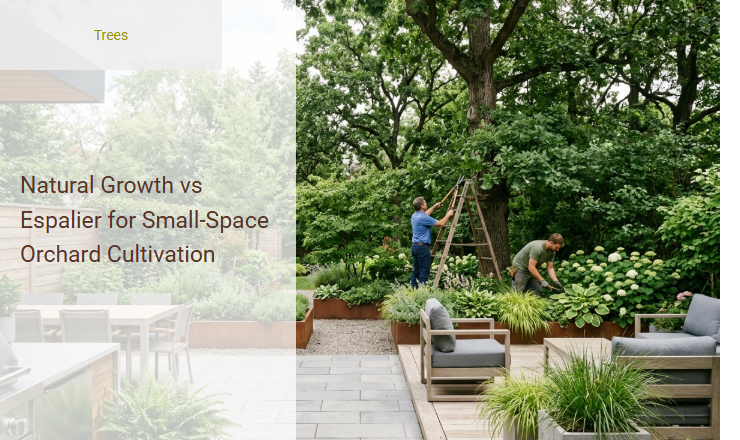
Gardening enthusiasts with limited yard space often face the frustrating realization that traditional fruit trees quickly outgrow their boundaries, leading to overcrowded yards and diminished yields. Before selecting specific tree varieties, urban growers must first evaluate how canopy management impacts light penetration and root competition in confined microclimates.
Choosing the right training methodology grants orchardists the ability to harvest abundant, high-quality fruit from footprints as small as a few square feet. However, success is predicated on understanding that both natural dwarfing habits and highly structured training systems require distinct levels of labor and pruning expertise. For instance, a naturally grown dwarf Fuji apple tree demands vastly different spatial planning than a multi-tier espaliered Bosc pear grown flat against a brick wall.
This article compares the maintenance labor, yields, and aesthetic outcomes of natural growth versus espalier systems to help you select the optimal framework for your small-space orchard.
Maximizing Tiny Plots: The Small-Space Orchard Dilemma
Modern urban living presents unique challenges for gardeners who dream of harvesting fresh, tree-ripened fruit. As residential lot sizes continue to shrink, the sprawling traditional orchard has become an impossible luxury for the average homeowner. This lack of physical space has sparked a fascinating debate in the horticultural world: should small-scale growers cultivate free-standing dwarf fruit trees allowed to grow naturally, or should they embrace the highly structured, two-dimensional art of espalier? Both methods offer unique pathways to food self-sufficiency, but they require entirely different spatial configurations, temporal commitments, and design sensibilities.
Choosing the right strategy is the critical first step toward transforming a cramped backyard, balcony, or side yard into a high-yielding agricultural sanctuary.
The Natural Approach: Embracing Unrestricted Dwarf Cultivation
Allowing fruit trees to develop their natural, three-dimensional form is the most traditional way to garden, even in a micro-orchard. Thanks to advanced agricultural grafting, growers can utilize dwarf and semi-dwarf rootstocks that genetically limit the tree's ultimate size without sacrificing fruit quality or size. This approach honors the plant's natural habit, allowing branches to reach outward and upward into a classic rounded canopy.
Embracing minimal intervention and letting the tree grow naturally offers several distinct benefits for the casual or busy gardener:
- Reduced systemic stress: Trees allowed to grow in their natural form experience less pruning shock, leading to stronger immune systems and better resistance to common garden pests.
- Lower initial infrastructure costs: Unlike trained trees, natural dwarf trees require no permanent trellis systems, heavy-duty wire arrays, or brick walls for physical support.
- Self-regulating growth: Once established, dwarf rootstocks naturally slow down their vegetative growth, allowing the gardener to step back and let nature do the heavy lifting.
Decoding Espalier: Artistry and Structure in Fruit Training
On the other side of the design spectrum lies espalier, a practice dating back to ancient Roman times and perfected in the walled gardens of medieval Europe. The word "espalier" refers both to the physical trellis support and the horticultural technique of training woody plants flat against a two-dimensional plane. By pruning away branches that grow outward and securing remaining branches to a horizontal, vertical, or fan-shaped framework, gardeners can cultivate full-sized fruit varieties in spaces only a few inches deep.
The historical genius of espalier lies in its manipulation of plant biology. By training branches horizontally, we slow the flow of sap, which naturally triggers the tree to allocate its energy away from leafy wood and into the heavy production of fruiting spurs. - Classical Horticultural Society Journal
Yield vs. Footprint: Comparing Fruit Production Density
When working with limited ground space, physical efficiency is the ultimate metric of success. While a natural dwarf tree produces a beautiful, voluminous canopy, its wide footprint can quickly overwhelm a narrow walkway or small patio. An espaliered tree, by contrast, takes up virtually no horizontal floor space, utilizing vertical wall surfaces that would otherwise go unused. Below is a comparative look at how these two methods partition space and yield.
| Cultivation Method | Required Ground Footprint | Relative Fruit Yield | Spatial Efficiency Rating |
|---|---|---|---|
| Natural Dwarf Canopy | 64 – 100 Square Feet | High (per tree) | Moderate |
| Two-Dimensional Espalier | 8 – 15 Square Feet | Moderate to High (per linear foot) | Excellent |
Solar Capture: Sunlight Optimization and Microclimates
Sunlight is the primary currency of fruit production, directly influencing the sugar content, coloration, and ripening timeline of your harvest. Three-dimensional natural tree crowns naturally shade their own interior branches, which can lead to uneven ripening and lower-quality fruit deep inside the canopy. Because espaliered trees are trained flat, every single leaf and fruit receives direct, unfiltered access to available sunlight.
This maximized exposure is especially valuable in northern climates or cool, shady urban microclimates where heat is at a premium.
Labor and Longevity: Maintenance Demands of Both Methods
Before selecting a cultivation style, it is vital to assess how much physical labor you are willing to invest in your small-space orchard. The maintenance schedules for these two methods represent opposite ends of the gardening spectrum.
- Dwarf Cultivation Labor: Natural dwarf trees require straightforward, low-intensity care. Pruning is typically performed once a year during winter dormancy to remove dead wood and maintain an open center.
- Espalier Cultivation Labor: Pruning is highly precise and multi-seasonal. Summer pruning is necessary to pinch back vigorous water sprouts, while winter maintenance involves checking wire tension, tying down new branches, and managing structural spurs.
- Productive Lifespan: While natural dwarf trees on highly dwarfing rootstocks can sometimes have shorter lifespans of 15 to 20 years, highly managed espaliered trees on semi-dwarf or standard rootstocks can remain highly productive for 50 years or more.
Visual Harmony: Landscaping and Aesthetic Value
Your garden is not just a food production facility; it is an extension of your home's aesthetic character. The visual impact of these two methods could not be more different. A free-standing dwarf tree offers a soft, classic charm that blends seamlessly into informal cottage gardens, wild meadows, or rustic landscapes. An espalier tree, however, functions as a living piece of architecture, providing striking structural lines, stunning spring blooms silhouetted against flat walls, and an elegant structural skeleton throughout the winter months.
Varietal Compatibility: Choosing the Right Tree for the Method
Not all fruit trees are biologically suited to every style of cultivation. Some species naturally produce fruit on long-lived woody spurs, making them perfect for structural training, while others fruit only on new growth and resist rigid confinement.
- Apples and Pears
- These are the absolute premier choices for the espalier method. Their highly flexible young wood is easy to train, and they bear fruit on permanent spurs that produce reliably year after year in tight configurations.
- Stone Fruits (Peaches, Plums, and Nectarines)
- These species fruit primarily on wood produced the previous year. Because they require constant renewal of fruiting wood, they are challenging to keep in formal geometric shapes, making them much better suited for natural dwarf cultivation or informal fan shapes.
- Citrus and Figs
- These species respond beautifully to natural dwarf habits and container planting. They naturally branch outward and are easily maintained in small footprints without the need for complex structural wiring.
Implementation Guide: Getting Started with Your Chosen System
No matter which system you select, setting up your small-space orchard correctly during the first year is critical to long-term success.
How to Plant a Natural Dwarf Tree
- Select a site with at least six to eight hours of direct sunlight and well-draining soil.
- Dig a hole twice as wide as the root ball, but only as deep, ensuring the graft union sits two to three inches above the final soil line.
- Mulch the root zone thoroughly with organic compost to retain moisture, keeping the mulch away from the bark of the trunk.
How to Set Up a New Espalier System
- Install a heavy-duty support system of anchor bolts and high-tensile wire spaced 18 inches apart along a sturdy wall, fence, or free-standing posts.
- Plant a young, flexible bare-root "whip" (a single, unbranched stem) about six inches away from the wire framework.
- Prune the whip back to the height of the first horizontal wire to stimulate dormant buds to grow sideways along the support structure.
The Verdict: Selecting Your Ideal Small-Space Orchard System
The choice between natural dwarf trees and structured espalier comes down to balancing your spatial limitations against your personal gardening style. If you are short on time, prefer an organic, rustic landscape design, and want to keep your setup simple, the natural dwarf method will reward you with plentiful fruit for minimal effort. If you have limited ground space, love architectural geometry, and find the process of regular, precise pruning to be a therapeutic hobby, the espalier system will turn your blank walls into a stunning, high-yield focal point. Every square foot of your garden holds incredible agricultural potential. Align your orchard choice with your lifestyle, and enjoy the sweet rewards of homegrown fruit from your micro-plot.
| Feature | Natural Growth | Espalier |
|---|---|---|
| Large 3D canopy; requires significant radial ground and air clearance. | Flat 2D plane; grows flush against walls, fences, or trellises. | |
| Low to moderate; requires basic annual pruning for health and shape. | High; demands frequent, precise pruning and structural training. | |
| Interior branches shaded; leads to uneven fruit ripening. | Maximized sun exposure; results in higher fruit quality per square foot. | |
| Harder to harvest and pest-control due to dense, tall canopy. | Easy eye-level harvesting, spraying, and netting. | |
| Informal, organic shade provider or privacy screen. | Formal, architectural living art and decorative boundary. |
Leave a comment