
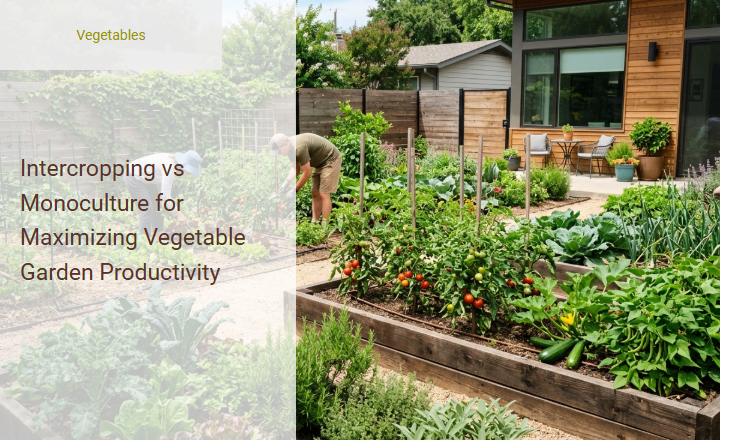
Many passionate backyard growers face the frustrating reality of stagnating vegetable yields and rapid soil depletion, despite dedicating endless hours to watering and weeding. Historically, we have defaulted to monoculture-planting single crops in tidy, isolated rows-largely because it is the familiar standard of large-scale industrial farming.
However, transitioning to strategic intercropping grants gardeners the unique ability to dramatically multiply their harvestable biomass within the exact same footprint. Of course, maximizing this productivity stipulates a nuanced understanding of plant biology; haphazardly mixing species can trigger intense resource competition. When executed systematically-such as pairing deep-rooted, heavy-feeding tomatoes with shallow-rooted, pest-repelling basil-companion planting optimizes resource distribution.
This comprehensive analysis will compare intercropping and monoculture across critical performance metrics, including spatial efficiency, pest suppression, and long-term soil health, to help you design a high-yielding layout tailored to your garden.
The Quest for Peak Garden Yields: An Introduction
For the modern home gardener, every square inch of soil represents an opportunity. As urban and suburban properties shrink, the challenge to produce an abundant harvest of fresh, organic vegetables becomes a puzzle of space optimization. Gardeners are forced to ask themselves a fundamental question: how can we extract the maximum amount of food from limited plots?
This quest has sparked a vibrant debate between two contrasting horticultural philosophies: the orderly predictability of monoculture and the complex, biodiverse patterns of intercropping. While one prioritizes streamlined management, the other mimics the efficiency of natural ecosystems to multiply yields in a single bed.
Understanding Monoculture: The Single-Crop Standard
Monoculture is the agricultural practice of growing a single crop species in a given area at a time. It represents the standard template of modern food production, designed to standardize planting, maintenance, and harvesting. This approach has its roots deep in industrial agriculture, where massive machinery and chemical inputs revolutionized food production by focusing on efficiency of scale.
When scaled down to the backyard level, monoculture translates directly to traditional row gardening and uniform raised beds. A gardener might dedicate an entire raised bed exclusively to carrots, or plant a long, neat row consisting solely of bush beans. In this setup, every plant in the designated zone competes for the exact same resources at the exact same time.
The Advantages and Pitfalls of Monoculture Farming
To make an informed decision for your garden, it is essential to weigh the benefits of single-crop planting against its significant ecological drawbacks.
- Ease of Management: Watering, fertilizing, and harvesting are highly streamlined because all plants have identical care requirements.
- Vulnerability to Pests: A single pest or disease can rapidly sweep through an entire bed, finding no natural barriers.
- Soil Depletion: Growing the same crop repeatedly in the same spot exhausts specific nutrients, requiring heavy heavy fertilization to restore balance.
Demystifying Intercropping: Nature's Companion System
Intercropping is the practice of cultivating two or more crop species in close proximity within the same garden bed. Unlike the sterile rows of industrial farms, this method seeks to replicate the rich biodiversity found in natural ecosystems, where plants support and balance one another.
"By combining species with different growth habits and nutrient needs, we can optimize the use of sunlight, water, and soil volume."
The core philosophy of intercropping revolves around synergy. Rather than fighting against nature to maintain a single-species bubble, gardeners use biodiversity to maximize space, deter pests, and improve the overall resilience of their backyard food systems.
The Science of Synergy: How Intercropping Works
Successful intercropping relies on understanding spatial and temporal dynamics to ensure plants cooperate rather than compete.
Methods of Multi-Crop Arranging
- Row Cropping: Growing different crops in alternating, closely spaced rows.
- Strip Cropping: Planting distinct crops in wider stripes that allow for easy access and rotation.
- Mixed Cropping: Planting multiple species together with no distinct row arrangement, maximizing ground cover.
- Relay Cropping: Planting a second crop into an existing standing crop before the first one is harvested, maximizing seasonal time.
Productivity Showdown: Land Equivalent Ratio (LER) Explained
To scientifically compare the productivity of monoculture and intercropping, agronomists use a metric called the Land Equivalent Ratio (LER). This ratio measures the relative land area required under monoculture to achieve the same yields produced by an intercropped mixture.
The mathematical formula is expressed as LER = (Yield of Crop A in Mix / Yield of Crop A in Monoculture) + (Yield of Crop B in Mix / Yield of Crop B in Monoculture). When the LER value is greater than 1.0, it indicates that intercropping is more productive than growing the crops separately.
For instance, an LER of 1.3 means that a monoculture system would require 30% more land to match the harvest output of the biodiverse intercropped plot, proving that polycultures are far superior at maximizing food per square foot.
Pest Control and Disease Prevention: Monoculture Vulnerability vs. Intercropping Defense
In a monoculture garden, pests find an uninterrupted buffet. Once a pest locates its host plant, it can hop, crawl, or fly from one neighboring leaf to another without restriction, leading to exponential population growth and severe crop damage.
The Natural Defense Mechanisms of Intercropping
Intercropping disrupts this cycle by creating physical and olfactory barriers. Volatile organic compounds released by aromatic herbs can mask the scent of nearby vegetable hosts, making them invisible to pests. Additionally, planting diverse flowering species attracts beneficial predatory insects, creating a self-regulating ecosystem that controls harmful infestations naturally.
Soil Nutrition and Water Efficiency: A Below-Ground Comparison
The battle for resources occurs just as intensely below the soil surface as it does above. Monocultures systematically deplete specific soil zones because every plant root reaches the exact same depth and absorbs the identical profile of nutrients.
Intercropping creates a highly efficient underground partnership by utilizing diverse plant profiles:
- Root Stratification: Deep-rooting crops draw nutrients from deep down, while shallow-rooted crops utilize the upper soil layers.
- Nutrient Complementarity: Nitrogen-fixing plants like legumes feed the soil, leaving vital resources for heavy-feeding neighbors.
- Moisture Retention: Broad-leafed ground crops act as a living mulch, shading the soil to reduce evaporation and lock in water.
Designing Your Garden: Practical Intercropping Combinations
Implementing intercropping in your home garden does not require complex scientific tools. You can start by implementing time-tested companion planting guilds that naturally maximize light and space.
Another classic combination pairs tomatoes with basil. The basil benefits from the light shade provided by the tall tomato plants, while its aromatic foliage helps repel thrips, hornworms, and flies, protecting the tomatoes.
Making the Choice: Which Method Fits Your Gardening Goals?
Choosing between monoculture and intercropping depends on your lifestyle, physical space, and overall priorities. If you prefer straightforward planning, uniform harvests, and easy maintenance cycles, monoculture rows remain a dependable option.
If your primary goal is to maximize yields in a compact urban footprint while fostering a resilient, pesticide-free environment, intercropping offers an incredibly rewarding path forward. By matching the right plant partners together, you can transform your backyard into a highly productive, self-sustaining ecosystem. Your decision will shape the health and abundance of your harvest for seasons to come.
| Yield Metric | Intercropping | Monoculture |
|---|---|---|
| Land Equivalent Ratio (LER) | Typically > 1.0; higher total biomass and yield per unit area. | Equals 1.0; baseline yield per unit area for a single crop. |
| Resource Efficiency | Optimized; diverse root depths and canopy heights utilize light, water, and nutrients efficiently. | Sub-optimal; crops compete for identical soil zones and light spectra simultaneously. |
| Pest & Disease Losses | Minimized; crop diversity disrupts pest lifecycles and limits disease spread. | Maximized; contiguous hosts facilitate rapid pest outbreaks and pathogen transmission. |
| Soil Fertility & Nutrition | Self-sustaining; integration of legumes fixes nitrogen, reducing synthetic fertilizer needs. | Depletive; rapid extraction of specific nutrients requires heavy chemical fertilization. |
| Harvest Window & Risk | Staggered; continuous harvest protects against total crop failure. | Concentrated; single harvest period increases vulnerability to market and weather shocks. |
| Management Complexity | High; requires manual planting, weeding, and selective harvesting. | Low; highly compatible with mechanization, standard inputs, and scale. |
Leave a comment