
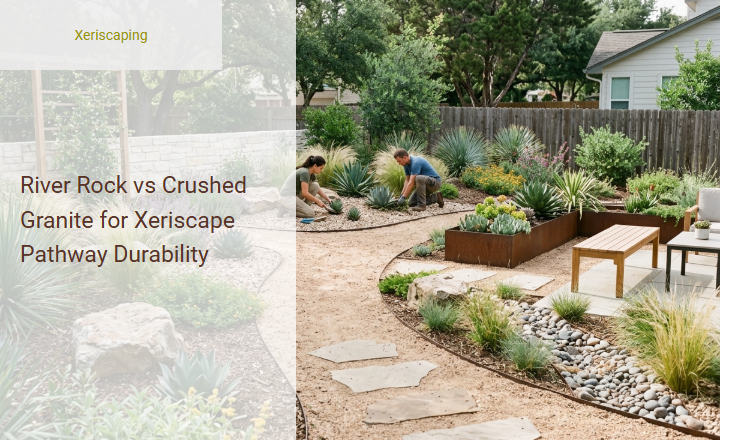
Designing a low-water landscape is a major investment, yet many homeowners quickly face the frustrating reality of pathways that wash away during heavy rains, shift underfoot, or become overrun by weeds. Before selecting a stone based solely on aesthetics, it is essential to first evaluate how traffic volume and slope gradients impact material longevity.
Choosing the correct aggregate guarantees a highly durable, zero-maintenance surface that elevates your property value while preventing costly erosion. However, as a crucial stipulation, even the premium stone options will fail without a properly compacted sub-base and weed barrier. For example, angular 3/8-inch crushed granite naturally packs down to create a firm, stroller-friendly walkway, whereas rounded 2-inch river rocks excel in drainage swales but will shift dangerously under heavy foot traffic.
This article compares river rock and crushed granite across key durability metrics, displacement resistance, and installation requirements to help you choose the ultimate foundation for your xeriscape.
Introduction to Xeriscape Pathway Materials
Designing a resilient and visually stunning outdoor space in arid regions requires careful planning, where water conservation and material longevity are paramount. When planning xeriscape pathways, homeowners typically find themselves choosing between two of the most popular ground covers: smooth, natural river rock and sharp, modern crushed granite. Both options bring distinct textures and colors to a desert landscape, but their physical performance varies significantly under harsh environmental conditions. In arid landscaping, durability is key because intense sun, high winds, and occasional flash floods can quickly erode lesser materials, turning a low-maintenance dream into a costly chore.
Understanding River Rock: Aesthetics and Physical Traits
Aesthetic Appeal of Rounded Stone
River rock consists of naturally weathered, water-rounded stones harvested from riverbeds and ancient deposits. These stones are famous for their smooth, gentle textures and soft, rounded edges, which have been polished by decades of natural water flow.
- Size Variations: Available in sizes ranging from small pebbles (about 3/8 inch) to large cobbles (3 to 5 inches or more) to suit different landscape scales.
- Natural Aesthetic Appeal: Showcases a soft, earthy palette of grays, tans, blues, and reds that deepen and intensify in color when wet.
- Smooth Texture: Offers a fluid, organic look that mimics natural water beds, making it ideal for dry creek designs.
Understanding Crushed Granite: Composition and Texture
Angular Composition of Fractured Stone
Crushed granite is a natural quarry product that has been mechanically fractured into small, sharp pieces. Unlike rounded river rocks, crushed granite is defined by its sharp, angular edges, which allow the individual particles to bind tightly together under compaction.
- Interlocking Nature: The jagged edges of the granite pieces nestle into one another, creating a semi-solid, stable surface that resists shifting.
- Earthy Color Palette: Available in an array of stunning hues, including gold, bronze, charcoal, red, and classic tan.
- Texture and Size: Usually sold as "decomposed granite" (DG) or small crushed stone containing fine particles that help with binding.
Stability and Shifting: How They Hold Up to Foot Traffic
When it comes to regular foot traffic, the physical structure of your pathway material determines how safe and stable it feels underfoot. River rock, with its smooth and rounded surfaces, acts much like marbles; when stepped on, the stones slide past one another, causing feet to sink and making walking a chore. Without a heavy-duty border or a deep sub-base, river rocks easily migrate out of the pathway boundaries.
In contrast, crushed granite excels under foot traffic. Because the angular stones lock together, they form a firm, highly stable surface that does not yield or sink easily. While loose crushed granite can still track slightly, the application of a liquid stabilizer or binder can lock the particles into a near-solid, concrete-like surface that remains porous yet highly resistant to shifting.
"For high-traffic pathways, a compactable material with angular edges is always superior to rounded stones, which continuously shift under pressure."
Weather Resistance: Managing Rain, Wind, and Erosion
Arid environments may be dry most of the year, but they are often subject to extreme weather events, including high winds and intense, sudden downpours. Erosion control is a critical factor when choosing between these two materials. River rock is highly effective at slowing down fast-moving water, which is why it is often used in drainage swales and dry creek beds. However, smaller sizes of river rock can easily wash away during torrential rains if the slope is too steep.
Crushed granite handles moderate rainfall beautifully because it is highly permeable, allowing water to soak directly into the ground. However, during severe storms, unstabilized crushed granite is highly susceptible to washouts and erosion, especially on sloped pathways. To prevent wind and rain from displacing the fine particles, homeowners must use a stabilizing binder or install physical barriers to keep the granite secure over time.
Weed Growth and Long-Term Maintenance
Maintaining a clean, weed-free xeriscape pathway requires ongoing effort, though the type of maintenance differs significantly between river rock and crushed granite.
- Weed Prevention: Organic debris settles easily into the large gaps between river rocks, creating a fertile ground for weeds to sprout. Crushed granite, when compacted tightly, makes it harder for airborne seeds to take root, though weeds can still emerge over time.
- Leaf Blowing and Cleaning: Cleaning leaves and twigs from river rocks is challenging because blowers can easily displace smaller rocks. Conversely, compacted crushed granite can be swept or blown clean with minimal displacement of the stone material.
- Replenishment Needs: Because river rocks do not break down, they rarely need replenishment. Crushed granite slowly decomposes and breaks down over several years, requiring a fresh top layer every three to five years to maintain its depth and color.
Walking Comfort and Accessibility
A pathway must be comfortable and accessible for all users, including pets and utility equipment. River rock is notoriously uncomfortable to walk on with bare feet or thin-soled shoes due to its uneven and shifting surface. It also poses a challenge for pet paws, as dogs can struggle to find stable footing on loose, rolling stones. Additionally, rolling wheeled equipment like wheelbarrows, strollers, or wheelchairs over river rock is virtually impossible without extreme effort.
Crushed granite offers a vastly superior user experience for daily transit. When properly compacted, it creates a flat, smooth, and firm surface that is highly accessible. It is comfortable for pets to walk on and easily supports the rolling wheels of lawn mowers, wheelbarrows, and strollers. For maximum accessibility, crushed granite with a stabilizer is the clear choice, offering a wheelchair-friendly path that mimics the firmness of asphalt while retaining a natural look.
Cost vs. Lifespan: Which Offers Better Value?
| Metric | River Rock | Crushed Granite |
|---|---|---|
| Initial Installation Cost | Moderate to High (higher material cost per ton) | Low to Moderate (affordable and easy to spread) |
| Lifespan | Virtually permanent (does not degrade) | Long-lasting (degrades slowly over time) |
| Replacement Cycle | Rarely needs replacement (may need washing or shifting back) | Needs a fresh top coat every 3 to 5 years |
| Maintenance Costs | Higher long-term weed control and manual cleaning | Low periodic replenishment and stabilizer reapplication |
Best Applications for River Rock and Crushed Granite
Choosing the right material depends heavily on the specific function of the area within your xeriscape design. Each material excels in different zones of the garden.
Where River Rock Excels
River rock is best utilized in non-traffic areas where its visual beauty and water-handling capabilities shine. It is the perfect choice for dry creek beds, decorative garden borders, drainage basins, and around the base of large desert plantings where it acts as a heavy, wind-resistant mulch.
Where Crushed Granite is the Superior Choice
Crushed granite is the premier choice for active use areas. It is highly suited for main garden walkways, patio seating areas, fire pit surrounds, and driveways where a flat, stable, and walkable surface is required for daily activities.
The Final Verdict on Durability
While both materials bring unique benefits to arid landscaping, they serve entirely different functional roles. River rock boasts incredible material longevity because it never breaks down, but its lack of stability makes it highly impractical as a walkable pathway material. It remains a decorative powerhouse best reserved for water management and borders.
When evaluating true pathway durability-which combines stability underfoot, resistance to shifting, and ease of maintenance-crushed granite is the winner. Its interlocking angular structure creates a dependable, safe, and highly resilient surface that withstands daily traffic and harsh weather when paired with a quality stabilizer. For a long-lasting, highly functional xeriscape path, compacted crushed granite delivers the best balance of performance, beauty, and value.
| Durability Aspect | River Rock | Crushed Granite |
|---|---|---|
| Structural Stability | Low. Smooth, rounded edges do not lock together; stones shift and roll under pressure. | High. Angular, sharp edges lock and compact tightly, creating a firm, solid surface. |
| Displacement & Erosion | High. Scatters easily outside pathway borders and washes away during heavy rainfall. | Low. Resists heavy rain erosion and stays in place, especially when mixed with stone dust. |
| Traffic Suitability | Low. Difficult to walk on; highly unstable for wheelchairs, strollers, or high heels. | High. Ideal for heavy foot traffic, wheeled equipment, and ADA-compliant pathways. |
| Maintenance Lifespan | Short-term. Requires deep border edging and frequent raking/replenishment to maintain depth. | Long-term. Low maintenance; requires only occasional topping off and minimal weeding. |
Leave a comment